Xiaomi HyperOS 4 Review: New Features, Design, Performance, AI and Global Update Guide
Introduction
Xiaomi has taken another major step in its software evolution with the introduction of Xiaomi HyperOS 4. The latest version of Xiaomi’s operating system focuses on a more refined visual experience, smoother performance, smarter artificial intelligence features, and improved privacy protection.
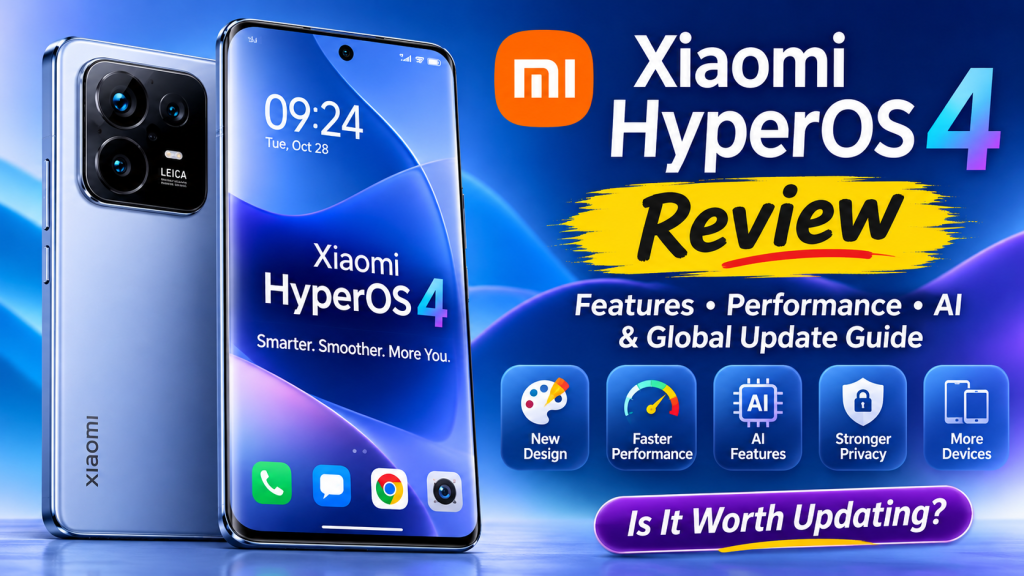
For years, Xiaomi users have wanted a software experience that combines attractive customization with reliable everyday performance. With HyperOS 4, Xiaomi is attempting to deliver exactly that.
The update introduces a redesigned interface called Soft Light Glass, improved animations, flexible lock screen customization, smarter widgets, and enhanced AI-powered productivity tools. Xiaomi has also worked on system-level optimizations designed to improve app launching, multitasking, and overall responsiveness.
But is Xiaomi HyperOS 4 really a meaningful upgrade? Does it offer enough improvements over HyperOS 3 to make users excited?
In this detailed review, we explore its design, performance, features, AI capabilities, privacy improvements, compatible devices, and overall value for global Xiaomi users.
What Is Xiaomi HyperOS 4?
Xiaomi HyperOS 4 is the latest generation of Xiaomi’s software platform, designed for compatible Xiaomi, Redmi, and POCO smartphones and tablets.
Rather than focusing exclusively on visual changes, Xiaomi has introduced improvements across several areas of the operating system.
The main objectives include:
- A more modern and visually appealing interface.
- Smoother animations and system navigation.
- Better memory management and app responsiveness.
- More useful AI-powered productivity tools.
- Improved customization options.
- Enhanced privacy and security protection.
- Better integration across Xiaomi devices.
HyperOS 4 is designed to create a more connected software experience across Xiaomi’s ecosystem.
Xiaomi HyperOS 4: What’s New?
One of the biggest attractions of HyperOS 4 is its collection of new features. Xiaomi has focused on making the operating system look more polished while improving the way users interact with their devices.
1. Soft Light Glass Design
The most noticeable change in Xiaomi HyperOS 4 is its new Soft Light Glass visual design.
This interface introduces refined transparency, softer lighting effects, improved depth, and more visually appealing transitions.
Instead of making everything look completely flat, Xiaomi uses layered visual elements to create a more modern appearance.
Key design improvements include:
- Glass-inspired interface elements.
- Dynamic lighting effects.
- Improved transparency.
- Refined visual hierarchy.
- Smoother transitions between menus.
- More polished system animations.
The overall design gives HyperOS 4 a fresh identity and makes everyday interactions feel more modern.
2. Improved Lock Screen Customization
Xiaomi has also improved lock screen personalization.
Users can enjoy more flexible clock styles, adjustable typography, and better visual arrangements.
The redesigned lock screen allows users to create a more personalized appearance without relying entirely on third-party applications.
Depending on the supported device, users can expect:
- Flexible clock sizing.
- Variable typography.
- More attractive visual layouts.
- Improved lock screen presentation.
These changes are particularly useful for people who enjoy customizing their smartphones.
3. Smarter Notifications and Widget Stacking
Notifications and widgets are essential parts of the smartphone experience.
HyperOS 4 introduces notification stacking to create a cleaner notification area. Instead of displaying everything in a crowded layout, notifications can be organized into a more manageable structure.
Widget stacking is another useful addition.
It allows users to organize multiple widgets in a smaller space and switch between them more efficiently.
This can help keep the home screen organized without sacrificing quick access to important information.
4. Resizable Home Screen Folders
Another interesting feature is improved home screen folder customization.
HyperOS 4 introduces more flexible folder resizing options on supported smartphones.
Users can organize applications according to their preferences and create a cleaner home screen.
For example, someone who frequently uses social media, photography, gaming, and productivity applications can organize them into larger or smaller folders.
This is a practical improvement for people who prefer a personalized home screen.
Performance and Speed: Is HyperOS 4 Faster?
Performance is one of the most important aspects of any smartphone operating system.
A beautiful interface means very little if applications open slowly or animations become inconsistent during everyday use.
Xiaomi says HyperOS 4 introduces several system-level optimizations to improve responsiveness.
Precision Workload Scheduling
HyperOS 4 introduces Precision Workload Scheduling to improve how system resources are managed.
The technology monitors workloads and adjusts resource allocation to maintain a more responsive experience.
This is intended to help with:
- Application launching.
- Background activity management.
- Multitasking.
- System responsiveness.
- Consistent performance during extended use.
Improved Memory Preloading
Memory Preloading is another important performance improvement.
The system uses AI-driven techniques to prepare memory resources more intelligently.
This approach is designed to make frequently used applications more responsive while helping the system manage available resources.
Faster Application Launching
Xiaomi also reports improvements in application launching and camera responsiveness.
According to Xiaomi’s internal laboratory comparisons on the Xiaomi 17 Ultra:
- The total hot-launch time for 30 applications after nine hours of use decreased from 40.3 seconds to 36.8 seconds.
- Rear-camera HDR photo capture time improved from 313.38ms to 240.16ms.
- Camera cold-launch time decreased from 1,043.6ms to 808.8ms.
These are manufacturer-reported results rather than independent benchmark findings. Actual performance will depend on the smartphone model and usage conditions.
Overall, the performance improvements look promising, particularly for users who regularly switch between applications.
Xiaomi HyperOS 4 AI Features
Artificial intelligence is becoming an increasingly important part of modern smartphone software.
Xiaomi HyperOS 4 expands its Xiaomi HyperAI experience with several productivity-focused features.
AI Voice Notes
AI Voice Notes is one of the most interesting additions.
It helps users capture voice recordings and organize information more efficiently.
Some of its capabilities include:
- Turning voice recordings into structured notes.
- Creating summaries.
- Extracting important tasks.
- Asking questions about saved notes.
- Generating mind maps.
For students, professionals, and people who frequently attend meetings, these features could save considerable time.
AI Speech Recognition
HyperOS 4 also introduces improved AI-powered speech recognition.
Its capabilities include:
- Meeting summaries.
- Automatic outline generation.
- Important information extraction.
- Visual markers within recordings.
- Skipping silent portions of recordings.
These tools are designed to make long recordings easier to understand and review.
AI Translation
AI Translate Conversation aims to make communication between people speaking different languages easier.
This feature can be particularly useful for travelers, international students, and people working with overseas clients.
However, supported languages, devices, and regional availability may vary.
AI Gallery Search
Finding a particular photograph in a large gallery can be frustrating.
HyperOS 4 introduces AI Gallery Search to help users locate images more easily using intelligent search capabilities.
Instead of manually scrolling through thousands of pictures, users can search for relevant content using supported search options.
AI Creativity Assistant
Xiaomi also provides AI-powered creative tools for supported devices.
These features are designed to help users edit images and explore different creative possibilities directly from their smartphones.
The availability of individual AI tools depends on the device, language, and region.
Privacy and Security Improvements
Smartphones contain personal photographs, messages, financial information, and other sensitive data.
For this reason, privacy and security are important considerations when evaluating a new operating system.
Xiaomi HyperOS 4 introduces additional security technologies, including:
- Improved data protection mechanisms.
- Edge-to-cloud AI data security.
- On-device privacy storage.
- Secure communication channels.
- Post-quantum encryption enhancements for certain communication scenarios.
Xiaomi describes these technologies as part of its broader effort to strengthen data protection.
However, the availability of some advanced privacy features is limited to supported devices and services.
Users should still follow standard security practices, such as installing official updates, using strong screen locks, and avoiding suspicious applications.
Xiaomi HyperOS 4 on Tablets and the Xiaomi Ecosystem
HyperOS is not limited to smartphones.
Xiaomi continues to develop its software platform for tablets and other connected devices.
HyperOS 4 brings improvements to tablet application layouts, navigation, and multitasking.
The larger display can benefit from more efficient application arrangements and flexible navigation options.
For users who own multiple Xiaomi products, the broader ecosystem approach is also important.
The goal is to make communication and interaction between compatible devices more convenient.
However, individual ecosystem features depend on hardware compatibility, software versions, and regional availability.
Xiaomi HyperOS 4 Supported Devices
Xiaomi has published a global rollout schedule covering selected Xiaomi, Redmi, and POCO devices.
The update is being distributed in multiple phases rather than reaching every compatible smartphone simultaneously.
Early November 2026
The initial global rollout group includes selected devices such as:
- Xiaomi 17 Ultra
- Xiaomi 17
- Xiaomi 17T Pro
- Xiaomi 17T
- Redmi Note 15 Pro+ 5G
- Redmi Note 15 Pro 5G
- Redmi Note 15 Pro
- Redmi Note 15 5G
- POCO F8 Ultra
- POCO F8 Pro
- POCO X8 Pro Max
- POCO X8 Pro
- Xiaomi Pad 8 Pro
- Xiaomi Pad 8
Mid-November 2026
The next rollout phase includes selected models such as:
- Xiaomi 15 Ultra
- Xiaomi 15
- Xiaomi 15T Pro
- Xiaomi 15T
- Redmi Note 17 Pro Max 5G
- Redmi Note 17 Pro 5G
- Redmi Note 17
- POCO F9 Ultra
- POCO F9 Pro
- POCO F7 Ultra
- POCO F7 Pro
- POCO F7
- POCO X8
- POCO X7 Pro
- Xiaomi Pad 7 Pro
December 2026
The December rollout phase includes selected older-generation models, including:
- Xiaomi 14 Ultra
- Xiaomi 14
- Xiaomi 13 Ultra
- Xiaomi 13 Pro
- Xiaomi 13
- Xiaomi 14T Pro
- Xiaomi 14T
- Xiaomi 13T Pro
- Xiaomi 13T
- Redmi Note 14 Pro+ 5G
- Redmi Note 14 Pro 5G
- Redmi Note 14 Pro
- Redmi Note 14 5G
- POCO F6 Pro
- POCO F6
- POCO X7
- POCO X6 Pro
Important: This is a selection of devices from Xiaomi’s published global rollout schedule, not an exhaustive compatibility list. The rollout timeline is estimated and may change depending on region, carrier, model, and development progress.
Not every device will receive every feature. Hardware limitations and regional software differences can affect availability.
How to Download and Install Xiaomi HyperOS 4
If your Xiaomi, Redmi, or POCO smartphone is eligible, checking for the update is relatively simple.
Follow these steps:
Step 1: Open Settings
Unlock your smartphone and open the Settings application.
Step 2: Select About Phone
Find and tap the About Phone section.
Step 3: Check the HyperOS Version
Tap the HyperOS version area to check for available software updates.
Step 4: Download the Update
If HyperOS 4 is available for your device, follow the on-screen instructions to download it.
Step 5: Install the Update
Before installation, make sure your phone has sufficient battery power and free storage space.
A stable Wi-Fi connection is recommended because major system updates can be large.
Step 6: Restart Your Smartphone
After installation, your phone may restart automatically. Allow the system to complete its initial setup and optimization.
If the update is not available, your device may be scheduled for a later rollout phase.
Xiaomi HyperOS 4: Pros and Cons
Pros
- Fresh Soft Light Glass interface.
- Improved lock screen customization.
- Better notification organization.
- Resizable home screen folders.
- More flexible widget management.
- System-level performance optimizations.
- Useful AI-powered productivity features.
- Enhanced privacy technologies.
- Improved tablet software experience.
Cons
- Not every feature is available on every device.
- Some AI tools have regional and language restrictions.
- The rollout is gradual.
- Certain visual effects depend on hardware capabilities.
- Manufacturer performance claims still require broader independent testing.
- The update may require significant download space.
Xiaomi HyperOS 4 vs HyperOS 3: What’s the Difference?
HyperOS 4 builds on the foundation of HyperOS 3, introducing improvements in design, performance, customization, and artificial intelligence.
| Feature | HyperOS 3 | HyperOS 4 |
|---|---|---|
| Interface | Previous visual design | Soft Light Glass |
| Lock screen | Existing customization | Flexible clock styling |
| Notifications | Previous layout | Notification stacking |
| Widgets | Standard widget management | Widget stacking |
| Folders | Existing folder options | Resizable folders |
| Performance | Previous optimizations | Improved workload scheduling |
| Memory | Existing management | AI-driven memory preloading |
| AI features | Existing Xiaomi AI tools | Expanded HyperAI capabilities |
| Privacy | Existing security features | Additional privacy technologies |
The biggest difference is the broader approach to improving the overall experience rather than simply changing the appearance of the interface.
Is Xiaomi HyperOS 4 Worth Updating To?
For most eligible users, HyperOS 4 looks like a worthwhile software upgrade.
The redesigned interface provides a fresh visual experience, while improvements to memory management and workload scheduling aim to make everyday tasks more responsive.
The AI features are another major attraction, especially for people who regularly record meetings, organize notes, translate conversations, or manage large photo collections.
However, the actual experience will depend on the device.
A recent flagship smartphone may support more advanced features than an older budget model.
Users who depend on their phones for work should also consider waiting a few days after an update becomes available to check for early reports about battery life, application compatibility, and software stability.
Frequently Asked Questions (FAQs)
1. What is Xiaomi HyperOS 4?
Xiaomi HyperOS 4 is the latest version of Xiaomi’s software platform for compatible Xiaomi, Redmi, and POCO smartphones and tablets. It introduces a redesigned interface, performance improvements, AI tools, and additional privacy features.
2. What are the biggest new features of HyperOS 4?
The major features include Soft Light Glass design, improved lock screen customization, notification stacking, widget stacking, resizable folders, AI Voice Notes, AI Speech Recognition, and performance optimizations.
3. Is HyperOS 4 based on Android 17?
HyperOS 4 is associated with Xiaomi’s latest Android platform generation. However, the underlying Android version should be verified against the specific device’s official firmware information rather than assumed to be identical across every model and region.
4. Which Xiaomi phones will receive HyperOS 4?
Selected Xiaomi 17, Xiaomi 15, Xiaomi 14, and Xiaomi 13 series devices are included in the published global rollout schedule. Eligibility and release timing vary by model and region.
5. Will Redmi and POCO phones receive HyperOS 4?
Yes. Xiaomi’s published rollout schedule includes selected Redmi Note, Redmi number-series, POCO F-series, POCO X-series, and POCO M-series devices.
6. Does HyperOS 4 improve battery life?
Xiaomi emphasizes performance and system efficiency improvements. However, battery life can vary depending on hardware, applications, settings, and usage habits. Independent testing is needed to establish the real-world battery impact.
7. Are all HyperOS 4 AI features available globally?
No. Some AI features are restricted by device model, language, and region. Global users should check the availability of individual features on their specific devices.
8. How can I check for the HyperOS 4 update?
Go to Settings, open About Phone, and tap the HyperOS version section. Your phone will check whether an update is available.
9. Is HyperOS 4 better than HyperOS 3?
HyperOS 4 introduces several improvements in visual design, customization, AI capabilities, and system performance. Whether it feels significantly better depends on the device and the features you use.
10. Should I install HyperOS 4 immediately?
If the update is officially available for your phone, installing it is generally recommended after checking its release notes and backing up important data. Users who prioritize stability may prefer to wait for early software feedback.
Final Verdict: Is Xiaomi HyperOS 4 a Major Upgrade?
Xiaomi HyperOS 4 represents an important step forward in Xiaomi’s software development.
The new Soft Light Glass design makes the interface look more modern, while improved customization options give users greater control over their smartphone experience.
Performance optimizations are promising, and the expanded Xiaomi HyperAI features could make everyday activities such as recording meetings, organizing notes, and searching photographs more convenient.
Its biggest limitation is feature availability. Not every Xiaomi, Redmi, or POCO smartphone will receive the same experience, and some AI tools will remain restricted to supported devices and regions.
Overall, Xiaomi HyperOS 4 looks like a promising upgrade for Xiaomi users, combining a refreshed interface with practical improvements in performance, productivity, and privacy.
For existing Xiaomi smartphone owners, it is certainly an update worth watching as the global rollout continues.