The $10000 Roadmap: A Comprehensive Guide to Saving Five Figures in a Single Year
Saving $10,000 in a calendar year is a landmark financial goal for many Americans. It represents more than just a five-figure sum; it is a “financial fortress”—a safety net that can cover a significant emergency, a substantial down payment on a car, or the seed money for a first home. However, in an era of fluctuating inflation and high living costs, the idea of cordoning off $833.33 every month can feel daunting. To achieve this in the United States, one must move beyond basic wishful thinking and employ a multi-front strategy that combines rigorous budgeting, lifestyle adjustments, and income optimization.
1. The Mathematical Foundation: Breaking Down the Goal
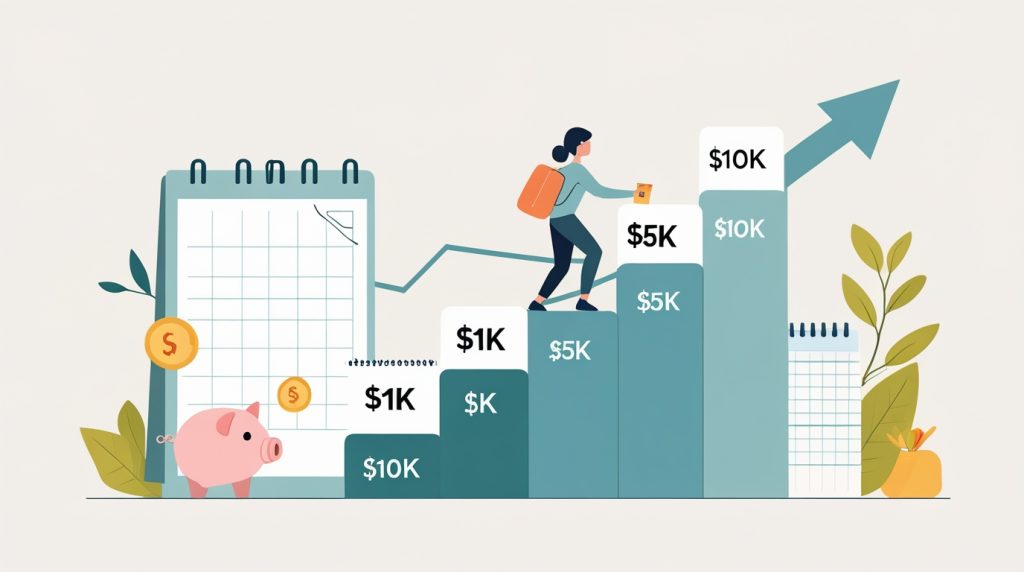
Before looking at bank accounts, you must look at the numbers. To reach $10,000 in twelve months, you need to save approximately $833.33 per month, $384.62 bi-weekly, or $192.31 per week.
Seeing the goal as a weekly figure of under $200 makes it feel more attainable than a lump sum of $10,000. The first step is a “Financial Audit.” For thirty days, track every single penny that leaves your account. Use apps like YNAB (You Need A Budget), Empress, or a simple Excel spreadsheet. Most people are shocked to find “leakage”—subscriptions they don’t use, premium convenience fees, and impulsive “Amazon-priming”—that often totals $200 to $400 a month alone.
2. Attacking the Big Three: Housing, Transport, and Food
In the U.S. economy, the “Big Three” expenses typically consume 60% to 70% of the average household’s income. To save $10,000, you must aggressively optimize these categories.
Housing: While you may not be able to move immediately, consider ways to decrease housing costs. This might mean taking on a roommate for a year, which could immediately cover the $833 monthly goal. If you are a homeowner, look into appealing your property tax assessment or shopping around for better homeowners’ insurance rates.
Transportation: The average new car payment in the U.S. has hovered around $700 recently. If you are driving a vehicle with a high monthly payment and high insurance premiums, you are fighting an uphill battle. If possible, “down-trade” to a reliable used vehicle paid in cash, or commit to a “no-drive” day once a week to save on gas and maintenance. Even a slight reduction in your insurance premium by increasing your deductible can contribute $500 over a year.
Food: This is the most flexible category and the one where most $10,000 goals are won or lost. The gap between “groceries plus meal prep” and “dining out plus delivery” is staggering. An average meal out in the U.S. costs roughly $20–$30, while a home-cooked meal costs $4–$7. By cutting out three restaurant meals a week and skipping the daily $6 latte, you can save nearly $400 a month.
3. The Power of “Gap” Management (Increasing Income)
Sometimes, cutting expenses isn’t enough. If your Take-Home Pay minus Essential Expenses doesn’t leave room for an $833 monthly surplus, you must focus on the “Gap”—the space between what you earn and what you spend.
The Side Hustle: In the American “gig economy,” there are dozens of ways to earn an extra $200 a week. This could be specialized freelancing (copywriting, graphic design, or bookkeeping), pet sitting via Rover, or driving for a ride-share service. If you dedicate 10 hours a week to a side hustle at a net rate of $20/hour, you have effectively solved the $833/month requirement without touching your primary paycheck.
Selling Modern Clutter: The average American household has thousands of dollars in unused items. Use platforms like Facebook Marketplace, Poshmark, or eBay to clear out electronics, designer clothing, or furniture. A dedicated weekend of “clutter-flipping” can often yield an initial $1,000 boost, giving you an immediate head start on your goal and providing psychological momentum.
4. Harnessing Financial Technology and Psychology
Saving is as much a psychological game as it is a mathematical one. To succeed, you must remove “human error” from the equation.
Automation: The most successful savers never “see” the money. Set up an automatic transfer from your paycheck or checking account to a dedicated savings account the day you get paid. If the money moves before you have a chance to spend it, you will naturally adjust your lifestyle to the remaining balance.
High-Yield Savings Accounts (HYSA): Do not let your $10,000 sit in a traditional big-bank savings account yielding 0.01% interest. At current rates, a High-Yield Savings Account (often found at online banks like Ally, Marcus, or SoFi) can offer 4% to 5% APY. Over the course of a year, as your balance grows toward $10,000, you could earn several hundred dollars in interest alone, which shortens your path to the finish line.
The 48-Hour Rule: To combat the consumerist culture of the U.S., implement a mandatory 48-hour waiting period for any non-essential purchase over $50. This cooling-off period eliminates the dopamine-driven impulse buy, which is the primary enemy of the $10,000 goal.
5. Managing Fixed Costs and “Hidden” Fees
Americans are often “nickeled and dimed” by services they forget they have. Use a service like Rocket Money or manually audit your bank statements to find recurring subscriptions.
Furthermore, call your internet service provider and cell phone carrier. In the U.S., these companies frequently have “retention offers” for customers who threaten to switch. Moving from a $90/month unlimited plan to a $30/month MVNO (like Mint Mobile or Cricket) saves $720 a year—nearly 10% of your total goal—for the exact same service.
6. Navigating Social Pressures
One of the hardest parts of saving $10,000 in a year is “lifestyle inflation” and social FOMO (Fear Of Missing Out). Your friends may want to go to expensive brunches, weekend trips, or concerts.
The key to staying on track is “Loud Budgeting.” Be transparent with your social circle. Instead of saying “I can’t afford it,” say “I am working toward a $10,000 savings goal this year, so I’m skipping the expensive dinners for now. Let’s do a potluck or a hike instead.” You will often find that your friends are also feeling financial pressure and will welcome the lower-cost alternatives.
Conclusion: The Compound Effect
Saving $10,000 in the USA requires a blend of defensive moves (cutting costs) and offensive moves (increasing income). It is a marathon that is won in the small, daily decisions: choosing the generic brand at the grocery store, resisting the urge to upgrade your smartphone, and consistently moving that $192 into your savings account every week.
At the end of the year, the reward is more than just a balance of $10,000. It is the development of a “wealth-building muscle” and the profound peace of mind that comes from knowing you are prepared for whatever the future holds. Once you have saved your first $10,000, you have the blueprint to save $20,000, $50,000, and beyond. The discipline remains the same; only the numbers change.