Top 10 Highest-Selling Mobile Phones Ever: The Best-Selling Phones in History
From simple feature phones with monochrome displays to powerful smartphones with professional-grade cameras, mobile phones have transformed dramatically over the past few decades. But which phones actually sold the most units?
The answer may surprise smartphone fans. While Apple’s iPhone dominates the modern smartphone era, several classic Nokia phones remain far ahead when lifetime unit sales are considered. The Nokia 1100, for example, has sold more than 250 million units, making it one of the most successful consumer electronics products ever produced.
In this article, we rank the top 10 highest-selling mobile phones ever, based on widely reported lifetime sales figures. Because manufacturers do not always publish audited model-by-model sales data, some figures are estimates and rankings can vary slightly between sources.
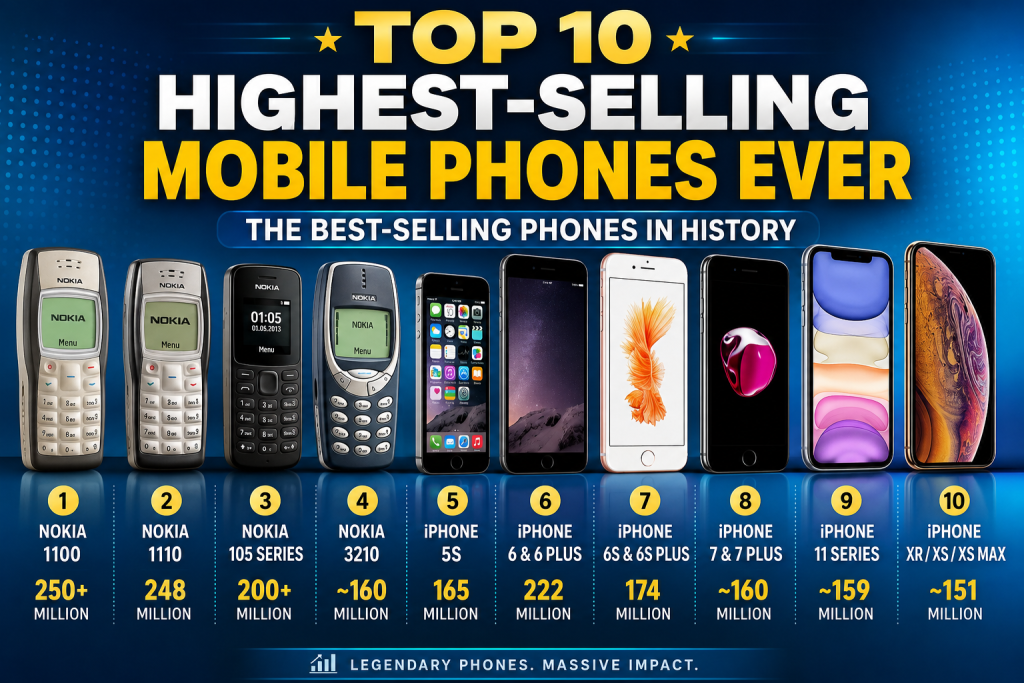
Quick Answer: Top 10 Best-Selling Mobile Phones Ever
| Rank | Mobile Phone | Approx. Lifetime Sales |
|---|---|---|
| 1 | Nokia 1100 | 250+ million |
| 2 | Nokia 1110 | 248 million |
| 3 | iPhone 6 & 6 Plus | 222 million |
| 4 | Nokia 105 Series | 200+ million |
| 5 | iPhone 6S & 6S Plus | 174 million |
| 6 | iPhone 5S | 165 million |
| 7 | Nokia 3210 | ~160 million |
| 8 | iPhone 7 & 7 Plus | ~160 million |
| 9 | iPhone 11 Series | ~159 million |
| 10 | iPhone XR / XS / XS Max | ~151 million |
Sales figures vary somewhat by source, particularly when multiple models or variants are grouped together. For example, some lists put the Nokia 3210 around 160–161 million units, while some sources use different groupings for Nokia and iPhone families.
1. Nokia 1100 — 250+ Million Units
Release: 2003
Manufacturer: Nokia
Estimated sales: 250+ million
The Nokia 1100 is widely recognized as the best-selling mobile phone model of all time.
Released in 2003, the phone was designed around a straightforward philosophy: make a mobile phone affordable, reliable and easy to use.
Its simple interface, physical keypad, compact design, long battery life and famous durability made it particularly popular in emerging markets.
The Nokia 1100 didn’t have a touchscreen, 4G, Wi-Fi or an advanced camera. Yet those limitations were actually part of its appeal. Users primarily wanted a dependable device for calling and texting.
The phone also featured practical additions such as a built-in flashlight and an easy-to-use interface.
Why was the Nokia 1100 so successful?
- Affordable price
- Excellent battery life
- Extremely durable construction
- Simple user interface
- Physical keypad
- Strong global distribution
- Particularly popular in developing markets
The Nokia 1100 demonstrates an important lesson in consumer technology: the most successful product isn’t necessarily the one with the most features.
2. Nokia 1110 — 248 Million Units
Release: 2005
Manufacturer: Nokia
Estimated sales: 248 million
The Nokia 1110 followed the same formula that made the 1100 successful.
With approximately 248 million units sold, it became one of the most successful mobile phones ever produced.
The phone was inexpensive, lightweight and incredibly straightforward.
For millions of first-time mobile users, the Nokia 1110 provided everything they needed:
- Voice calls
- SMS messaging
- Alarm
- Basic games
- Contact storage
- Long battery life
Its success also benefited from the rapid expansion of mobile networks in developing countries during the mid-2000s.
Nokia 1110 vs Nokia 1100
The two phones shared a similar philosophy, but the 1110 was designed as an even more basic mass-market device.
Together, these two Nokia models sold nearly 500 million units, illustrating just how dominant Nokia was during the feature-phone era.
3. Apple iPhone 6 & iPhone 6 Plus — 222 Million Units
Release: 2014
Manufacturer: Apple
Estimated combined sales: 222 million
The iPhone 6 and iPhone 6 Plus are the most successful iPhones ever when the two models are counted together, with widely reported combined sales of around 222 million units.
These phones represented a major change in Apple’s smartphone strategy.
The standard iPhone 6 introduced a larger 4.7-inch display, while the iPhone 6 Plus offered a 5.5-inch display.
At the time, many Android manufacturers were already producing large-screen phones. Apple entering the larger-display market helped accelerate the mainstream adoption of bigger smartphones.
Key features included:
- 4.7-inch and 5.5-inch Retina HD displays
- Apple A8 processor
- 8MP rear camera
- Touch ID
- Apple Pay support
- iOS ecosystem
- Premium aluminum design
The iPhone 6 generation demonstrated that consumers wanted smartphones that combined a large display with a relatively thin and lightweight design.
4. Nokia 105 Series — 200+ Million Units
Release: 2013
Manufacturer: Nokia
Estimated sales: 200+ million
The Nokia 105 continued Nokia’s successful feature-phone strategy long after smartphones had become mainstream.
The phone was inexpensive, compact and focused on the basics.
Unlike premium smartphones, the Nokia 105 targeted people who wanted a simple communication device rather than a mobile computer.
Its popularity has been especially strong in markets where affordability, battery life and durability remain important purchasing factors.
Why people bought the Nokia 105
The Nokia 105 offered:
- Affordable pricing
- Long-lasting battery
- Simple interface
- Physical keypad
- FM radio on some versions
- Compact design
- Strong durability
The Nokia 105 also illustrates why feature phones have not completely disappeared despite the dominance of Android and iPhone devices.
5. iPhone 6S & iPhone 6S Plus — 174 Million Units
Release: 2015
Manufacturer: Apple
Estimated sales: 174 million
The iPhone 6S and 6S Plus continued the success of the iPhone 6 family.
According to widely cited historical sales estimates, the two models together reached approximately 174 million units.
The phones introduced several important improvements over the previous generation.
Major highlights
- Apple A9 processor
- 12MP rear camera
- 4K video recording
- 3D Touch
- Improved aluminum construction
- Touch ID
- iOS ecosystem
The 6S generation was also notable because Apple continued to support the devices with software updates for many years, helping extend their useful lifespan.
6. iPhone 5S — 165 Million Units
Release: 2013
Manufacturer: Apple
Estimated sales: 165 million
The iPhone 5S was one of Apple’s most influential early smartphones.
It introduced Apple’s Touch ID fingerprint sensor to the iPhone lineup and featured the A7 chip, which Apple positioned as a major performance advancement.
Its relatively compact 4-inch display may look small compared with modern phones, but at the time the combination of premium construction, performance and software integration made the iPhone 5S highly desirable.
The iPhone 5S also benefited from Apple’s strong global distribution and the growing popularity of the iOS ecosystem.
7. Nokia 3210 — Around 160 Million Units
Release: 1999
Manufacturer: Nokia
Estimated sales: Approximately 160–161 million
The Nokia 3210 is one of the most iconic mobile phones ever made.
Released in 1999, it became enormously popular thanks to its compact design, internal antenna and customizable covers.
But one feature became particularly legendary:
Snake.
The game helped make the Nokia 3210 memorable to an entire generation of mobile-phone users.
The phone also helped establish the idea that a mobile phone could be a personal lifestyle product rather than simply a business communication device.
8. iPhone 7 & iPhone 7 Plus — Around 160 Million Units
Release: 2016
Manufacturer: Apple
Estimated sales: Approximately 160 million combined
The iPhone 7 and 7 Plus were another major success for Apple.
The iPhone 7 Plus was particularly important because it introduced a dual-camera system that helped establish computational photography and portrait photography as major smartphone selling points.
Major features
- Apple A10 Fusion chip
- Improved cameras
- Dual-camera system on iPhone 7 Plus
- IP67 water and dust resistance
- Retina HD display
- Touch ID
- iOS ecosystem
The removal of the traditional 3.5mm headphone jack was controversial, but the phone remained extremely popular.
9. iPhone 11 Series — Around 159 Million Units
Release: 2019
Manufacturer: Apple
Estimated sales: Around 159 million for the commonly cited iPhone 11 family grouping
The iPhone 11 became one of Apple’s biggest modern smartphone successes.
The standard iPhone 11 offered a combination of performance, camera capability and a lower price than Apple’s Pro models.
Key features
- Apple A13 Bionic
- Dual rear cameras
- Night mode
- Ultra-wide camera
- Face ID
- Wireless charging
- Water resistance
- Strong battery life
The iPhone 11 was also successful because it appealed to mainstream consumers rather than only premium smartphone buyers.
10. iPhone XR / XS / XS Max — Around 151 Million Units
Release: 2018
Manufacturer: Apple
Estimated sales: Around 151 million for the commonly grouped family
The final entry on our list is the iPhone XR/XS generation, which helped Apple expand its premium smartphone portfolio.
The iPhone XR became particularly important because it offered many flagship iPhone features at a lower starting price than the XS models.
The XS and XS Max targeted users looking for a more premium experience.
iPhone XR highlights
- 6.1-inch Liquid Retina display
- A12 Bionic chip
- Single 12MP camera
- Face ID
- Wireless charging
- Multiple color options
The combination of the XR’s relative affordability and the XS models’ premium positioning helped make this generation commercially successful.
What Makes These Phones the Best-Selling Ever?
Looking at the list reveals an interesting pattern.
The world’s best-selling phones weren’t necessarily revolutionary in terms of technical specifications. Instead, they succeeded because they delivered what consumers actually wanted at the right time.
1. Affordable Pricing
Nokia’s biggest advantage was affordability.
The Nokia 1100 and 1110 were accessible to consumers who could not afford expensive smartphones.
2. Reliability
Feature phones were often expected to survive years of everyday use.
Long battery life and durable construction were major selling points.
3. Simple User Experience
A phone doesn’t need dozens of apps to be successful.
For many consumers, calling, texting, contacts and basic entertainment were enough.
4. Strong Brand Recognition
Nokia became synonymous with mobile phones during the feature-phone era.
Apple later achieved something similar in the smartphone market through the iPhone ecosystem.
5. Global Availability
Distribution was another major factor.
A phone can only become a mass-market phenomenon if consumers can actually buy it.
Nokia vs Apple: Who Dominated Mobile Phone History?
The top 10 list tells an interesting story.
Nokia dominated the feature-phone era, while Apple dominates the smartphone era.
Nokia’s 1100 and 1110 alone account for nearly half a billion units. Meanwhile, Apple’s iPhone 6 generation remains one of the strongest smartphone-selling successes ever.
This represents two completely different approaches.
| Nokia Era | Apple Era |
|---|---|
| Affordable phones | Premium smartphones |
| Physical keypad | Touchscreen |
| Long battery life | Powerful processors |
| Calling & SMS | Apps & services |
| Simple software | Full mobile ecosystem |
| Durability | Advanced design |
| Mass-market affordability | Premium + mainstream tiers |
Are These the Best-Selling Smartphones or All Mobile Phones?
This distinction is important.
If we include all mobile phones, feature phones dominate the top positions.
The Nokia 1100 and Nokia 1110 remain ahead of most smartphones in lifetime unit sales.
If we restrict the ranking to smartphones, Apple’s iPhone family becomes much more dominant.
The iPhone 6 and 6 Plus are generally regarded as the best-selling smartphone generation, with around 222 million combined units according to widely cited estimates.
Why Are Old Nokia Phones Still So Popular?
The popularity of classic Nokia phones isn’t simply nostalgia.
Many users still appreciate them for practical reasons:
Long battery life
A basic phone can often last much longer between charges than a modern smartphone.
Durability
Classic Nokia devices became famous for surviving drops and everyday abuse.
Simple operation
There are no social media notifications, endless apps or complicated settings.
Low cost
Feature phones remain attractive to consumers looking for an inexpensive communication device.
Secondary phone use
Some people use basic phones as backup devices, travel phones or emergency communication tools.
What About Today’s Best-Selling Smartphones?
The smartphone market has changed dramatically.
In recent years, Apple and Samsung have dominated many global smartphone sales rankings. For example, Counterpoint-based reporting showed Apple’s iPhone 17 leading global smartphone sales in Q2 2026, with the iPhone 17 Pro Max and iPhone 17 Pro also occupying top positions.
However, annual best-selling smartphone rankings are not the same as all-time lifetime sales rankings.
A phone released recently simply has not had enough time to accumulate the hundreds of millions of units that older models achieved over several years.
What We Can Learn From the Best-Selling Phones Ever
The biggest lesson is that successful mobile phones usually combine several factors rather than relying on one specification.
A great camera alone doesn’t guarantee huge sales.
A powerful processor doesn’t guarantee huge sales.
Even a low price doesn’t guarantee success.
The biggest winners typically offer the right combination of:
- Price
- Reliability
- Design
- Battery life
- Usability
- Brand reputation
- Availability
- Timing
- Consumer demand
That’s why the Nokia 1100 could sell more units than many technologically far more advanced smartphones.
Frequently Asked Questions
What is the best-selling mobile phone of all time?
The Nokia 1100 is widely cited as the best-selling individual mobile phone ever, with more than 250 million units sold.
What is the second best-selling phone ever?
The Nokia 1110 is generally ranked second, with approximately 248 million units sold.
What is the best-selling iPhone ever?
The iPhone 6 and iPhone 6 Plus, when combined, are widely cited as Apple’s best-selling iPhone generation, with around 222 million units.
Is Nokia 1100 still the best-selling phone?
Yes, based on widely reported lifetime sales estimates, the Nokia 1100 remains at or near the top of all-time mobile-phone rankings.
Which company has the most phones on the all-time list?
Nokia has an exceptionally strong presence among the highest-selling phones because of its dominance during the feature-phone era. Apple dominates the smartphone portion of the list.
Why did Nokia phones sell so many units?
Nokia combined affordable prices, durability, simple software, long battery life and worldwide distribution. These characteristics were particularly valuable when mobile phones were first becoming widely available.
Final Verdict
The history of the world’s best-selling mobile phones is essentially a story of two eras.
Nokia ruled the feature-phone revolution, with legendary devices such as the Nokia 1100, Nokia 1110 and Nokia 3210 reaching extraordinary sales numbers.
Then Apple transformed the industry with the iPhone. Models such as the iPhone 6, iPhone 6S, iPhone 7 and iPhone 11 proved that smartphones could achieve mass-market sales on a scale previously associated with basic Nokia handsets.
The most important takeaway is simple: the best-selling phone isn’t necessarily the phone with the most advanced technology. It’s the phone that gives millions of people exactly what they need at the right price and at the right time.
As of 2026, the Nokia 1100’s extraordinary 250+ million-unit lifetime sales remain a benchmark that modern smartphones have yet to surpass on an individual-model basis.