What Happened to the Awami League? An Overview
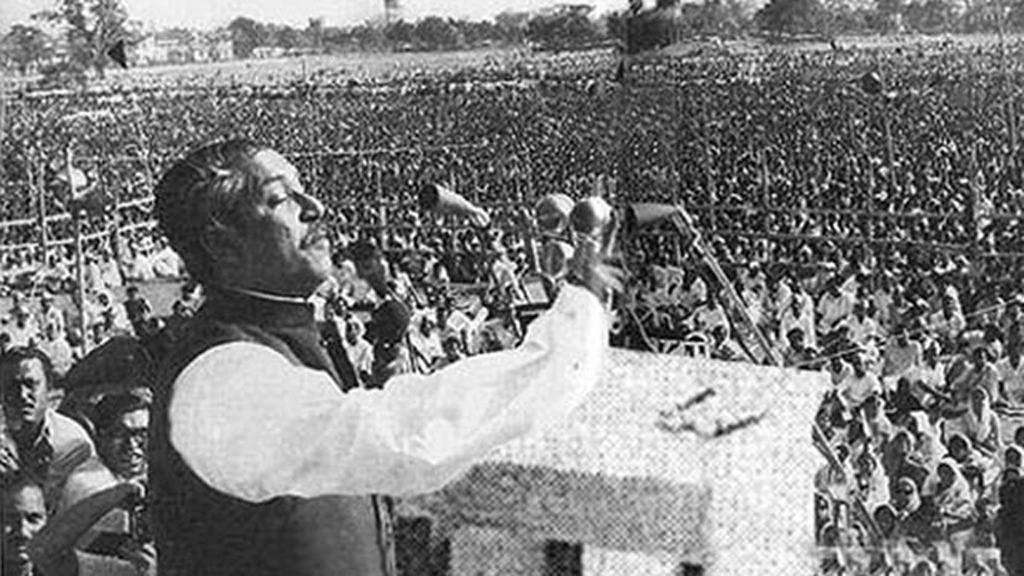
The Bangladesh Awami League was once the dominant political force in Bangladesh. For much of the period from 2009 to 2024, it controlled the national government under the leadership of Sheikh Hasina. Its political identity was closely associated with Bangladesh’s independence movement, secular nationalism, economic development and the legacy of Sheikh Mujibur Rahman.
That political dominance changed dramatically in August 2024.
A student-led uprising and a wider anti-government movement forced Sheikh Hasina to leave office and leave Bangladesh. An interim government was subsequently formed, and the country’s political landscape began changing rapidly.
By 2025, the Awami League faced severe legal and political restrictions. In May 2025, the interim government banned the party’s activities under the Anti-Terrorism Act, while the Election Commission suspended its registration.
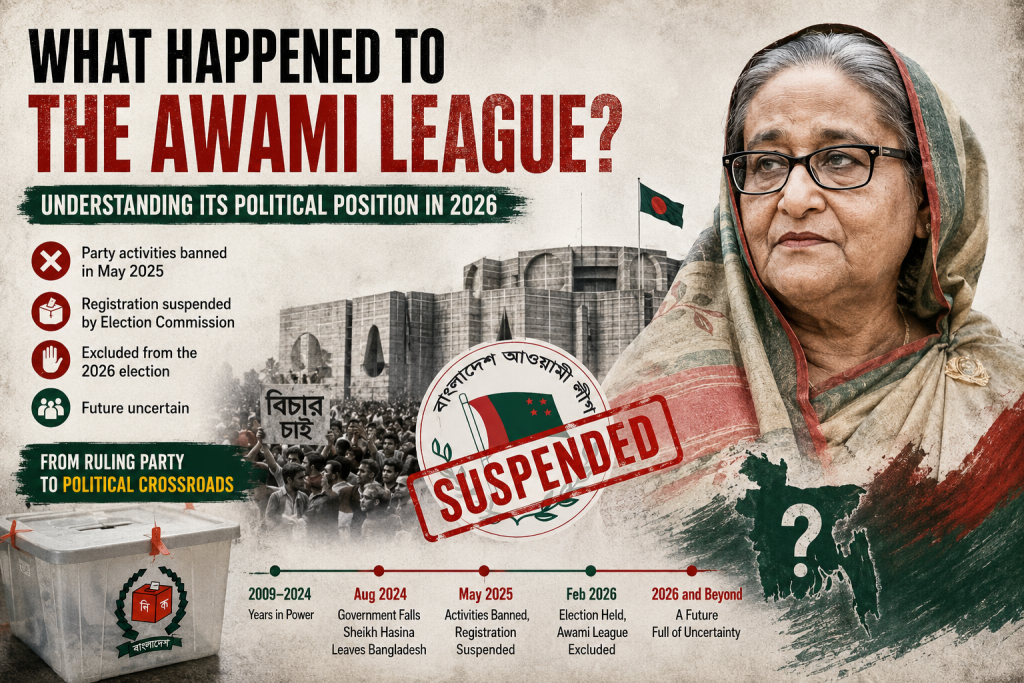
The consequences became especially clear during Bangladesh’s 2026 parliamentary election, when the Awami League was not permitted to participate. The election instead produced a major victory for the Bangladesh Nationalist Party (BNP), led by Tarique Rahman.
So, what exactly happened to the Awami League?
The short answer is that the party moved from being the country’s governing political machine to an excluded and legally restricted political organization whose future remains uncertain.
But the complete story is considerably more complicated.
The Awami League Before the 2024 Crisis
To understand the party’s position in 2026, it is important to understand how powerful it had become.
The Awami League returned to government in 2009 after winning the 2008 general election. Sheikh Hasina subsequently became one of the longest-serving political leaders in Bangladesh’s history.
During its years in power, the government emphasized:
- economic growth;
- infrastructure development;
- digitalization;
- electricity and energy expansion;
- poverty reduction;
- social development;
- women’s participation in the economy;
- closer relations with India;
- and the prosecution of people accused of crimes committed during the 1971 Liberation War.
The party also presented itself as the political heir of Bangladesh’s independence movement.
However, its long period in government also generated substantial criticism.
Opposition parties, rights organizations and critics accused the government of weakening democratic institutions, restricting political opposition, suppressing dissent and manipulating electoral competition.
Supporters of the Awami League rejected many of these accusations and argued that the government had maintained stability while delivering substantial economic and infrastructure development.
Both aspects are important for understanding why the party remains politically significant even after losing power.
The Turning Point: The 2024 Uprising
The decisive turning point came in 2024.
Student protests initially centered on government-job quota issues but eventually developed into a much broader anti-government movement. The confrontation between protesters and the authorities became increasingly violent.
The unrest eventually resulted in Sheikh Hasina leaving Bangladesh in August 2024.
The political consequences were enormous.
A government that had appeared deeply entrenched only months earlier was suddenly gone.
An interim administration led by Nobel laureate Muhammad Yunus took responsibility for governing the country and began pursuing political, institutional and legal reforms.
The fall of the Hasina government also triggered investigations into allegations surrounding the conduct of the former administration and the violence associated with the 2024 uprising.
The Awami League consequently moved from the center of state power to the center of a national debate over accountability, democracy and political inclusion.
Why Was the Awami League Banned?
This is one of the most important questions—and also one where terminology matters.
In May 2025, the interim government announced a ban on the activities of the Awami League and associated organizations. The government cited allegations connected to killings, crimes against humanity and other serious offenses during the 2024 uprising. The Election Commission subsequently suspended the party’s registration.
Legal changes in 2025 also expanded the framework under which political organizations could face proceedings before the International Crimes Tribunal. An official amendment provided the tribunal with powers that could include suspending or prohibiting an organization’s activities, banning an organization, suspending or canceling its registration, and confiscating property in circumstances covered by the law.
Therefore, it is useful to distinguish between several developments:
1. Political activities were banned.
2. The Election Commission suspended the Awami League’s registration.
3. The party was consequently excluded from the 2026 parliamentary election.
The Election Commission’s own website continues to list the organization as “Bangladesh Awami League (Suspended)”, with registration number 006.
This means that, as of August 2026, the Awami League has not simply become an ordinary opposition party.
Its formal political activities remain restricted, and its electoral position remains suspended.
The Awami League and the 2026 Election
The 2026 parliamentary election was a major milestone in Bangladesh’s post-2024 political transition.
The Awami League did not contest the election.
Instead, the principal competition was between the BNP-led political bloc and an opposition alliance led by Jamaat-e-Islami and other parties. The BNP ultimately secured a large parliamentary majority, bringing Tarique Rahman to the position of prime minister.
This fundamentally changed Bangladesh’s political map.
For the first time in many years, the Awami League had no parliamentary presence through its own candidates.
That does not necessarily mean that the party’s social or historical influence disappeared.
Political organizations can lose formal power while retaining supporters, networks, ideological influence and electoral constituencies.
The question is therefore not simply whether the Awami League still exists.
The more important question is:
Can the Awami League eventually return to competitive electoral politics?
Where Is Sheikh Hasina Now?
Sheikh Hasina remains the central figure in the Awami League’s political identity.
After leaving Bangladesh in August 2024, she remained in India.
Her legal situation has also become extremely serious. In November 2025, a Bangladeshi tribunal sentenced her to death in absentia over allegations connected to the crackdown during the 2024 uprising. Hasina has rejected the accusations and described the proceedings as politically motivated.
Her position has therefore become closely connected to the future of the party.
In August 2026, Hasina publicly called for the ban on the Awami League to be lifted and said that she intended to return to Bangladesh in December. The Bangladeshi government strongly criticized her remarks, while India has been reviewing Bangladesh’s extradition requests under its legal procedures.
Her potential return could therefore become an important political event.
However, there is a major distinction between Hasina’s personal political ambitions and the legal status of the Awami League as an organization.
The two issues are related, but they are not identical.
Is the Awami League Completely Finished?
It is too early to make that conclusion.
The party has suffered an extraordinary loss of institutional power, but political parties do not necessarily disappear simply because they lose office or face electoral restrictions.
The Awami League has a long history, extensive organizational experience and a large historical constituency.
Its supporters include people who associate the party with:
- the 1971 Liberation War;
- Sheikh Mujibur Rahman’s political legacy;
- secular nationalism;
- economic development;
- social welfare;
- infrastructure projects;
- and Bangladesh’s relationship with India and other regional powers.
At the same time, there is a large segment of Bangladeshi society that associates the party’s most recent period in power with authoritarianism, political repression, election controversies and alleged human-rights abuses.
This division is crucial.
The Awami League’s future will depend not only on whether the legal restrictions are removed, but also on whether the organization can rebuild public trust.
The Biggest Problem: Political Legitimacy
The Awami League faces a difficult legitimacy problem from several directions.
From its opponents
Opponents argue that the party’s leadership should be held accountable for alleged abuses committed during its years in power, particularly during the 2024 uprising.
They argue that simply restoring the party to electoral politics without accountability would undermine justice.
From its supporters
Supporters argue that banning an established political party excludes a large number of citizens from political participation.
They also argue that political disputes should ultimately be resolved through elections rather than permanent exclusion.
From a democratic perspective
The central challenge is finding a balance between accountability and political participation.
A functioning democracy needs mechanisms for prosecuting serious crimes.
At the same time, democracy also depends on political pluralism and the ability of citizens to support political alternatives.
How Bangladesh ultimately resolves this tension will be important not only for the Awami League but for the country’s entire political system.
What Happened to the Party’s Grassroots Network?
The Awami League historically possessed one of the largest grassroots political networks in Bangladesh.
Its organizational structure extended from national leadership to districts, upazilas, municipalities, unions and local communities.
The 2024 political upheaval disrupted this network.
Many senior leaders went into hiding, left the country or faced legal cases. Party offices were attacked or closed in different locations, while ordinary activists faced political uncertainty.
The ban on party activities also made normal organizational operations extremely difficult.
As a result, the Awami League’s political structure in 2026 is dramatically weaker than it was before August 2024.
But weakened does not necessarily mean eliminated.
A party with decades of organizational history can retain informal networks even when formal political activity is restricted.
The Role of Awami League Supporters
One of the most overlooked aspects of the current situation is the distinction between a political party and its voters.
Not everyone who voted for the Awami League necessarily supports every action of its leadership.
Likewise, not every critic of the Awami League necessarily supports the BNP, Jamaat-e-Islami or another political organization.
Bangladesh’s electorate is diverse.
Millions of citizens have political preferences based on family history, ideology, religion, economic interests, local relationships, development policies and personal experiences.
Therefore, even if the Awami League remains legally excluded, the political preferences that previously produced support for the party do not automatically disappear.
This creates an important long-term question:
Where will those voters go if the Awami League cannot contest elections?
They may remain politically disengaged, support another party, vote for independent candidates, or wait for a future opportunity for the Awami League or a successor organization to participate.
Why the Awami League Still Matters in 2026
Even without parliamentary representation, the Awami League remains important for several reasons.
1. Historical importance
The Awami League is inseparable from Bangladesh’s political history and the country’s independence narrative.
2. Former governing experience
The party governed Bangladesh for many years and shaped major areas of economic and foreign policy.
3. Large historical constituency
The organization developed a substantial nationwide voter and supporter base.
4. Sheikh Hasina’s continuing political role
Hasina continues to speak publicly and remains the most recognizable figure associated with the party.
5. The debate over political inclusion
The party’s exclusion has become part of a larger national debate over what political accountability should look like after a major political upheaval.
For these reasons, the Awami League remains a significant political issue even though it is not currently participating in elections.
The BNP’s Return to Power Changes the Equation
The February 2026 election dramatically changed Bangladesh’s political balance.
The BNP, led by Tarique Rahman, returned to government after years of opposition. The party won a large majority and formed the new government.
This creates a new political environment.
For many years, Bangladeshi politics was dominated by competition between the Awami League and BNP.
Now, the Awami League is outside the electoral system while the BNP is in government.
That means the traditional two-party balance has been interrupted.
Other forces—including Jamaat-e-Islami, the National Citizen Party and smaller parties—also gained greater importance during the 2026 election.
The question is whether Bangladesh will develop a genuinely more competitive multiparty system or whether politics will again become dominated by two major political blocs.
Could the Awami League Return to Politics?
There is no certain answer.
Several conditions would likely have to change before a full political comeback became possible.
Legal restrictions
The current suspension of registration and activity restrictions would need to be resolved.
Accountability proceedings
Cases involving Awami League leaders, including Sheikh Hasina, remain a major issue.
Leadership
The party may eventually need to determine whether its future should remain centered on Sheikh Hasina or whether a new generation of leadership should emerge.
Organizational restructuring
Years of disruption have weakened the party’s formal structure.
Public trust
The party would have to address the accusations and criticisms associated with its final years in government.
Electoral strategy
If eventually allowed to compete, the party would need to determine how to appeal to a changed electorate.
For these reasons, a simple return to the political model of 2010–2023 appears unlikely.
If the party returns, it may need to undergo significant political and organizational transformation.
Could There Be an Awami League Without Sheikh Hasina?
This may become one of the most important questions of Bangladesh politics.
For decades, Sheikh Hasina was not simply the leader of the Awami League—she was the dominant face of the party.
That created both strength and vulnerability.
Her leadership provided:
- continuity;
- organizational discipline;
- a recognizable national identity;
- and a strong connection with the party’s historical legacy.
But it also meant that the party became heavily personalized around one leader.
If the Awami League eventually returns to electoral politics, it may face pressure to develop a broader leadership structure.
A post-Hasina Awami League, if one emerges, could look very different from the organization that governed Bangladesh before 2024.
The International Dimension
The Awami League’s future is also connected to Bangladesh’s foreign relations.
India has historically maintained close relations with the Awami League government under Sheikh Hasina.
After Hasina’s departure, Bangladesh-India relations became more complicated.
Dhaka has requested Hasina’s extradition, while India has said that it is considering the requests through its legal framework.
Hasina’s continued presence in India therefore remains both a domestic political issue and a bilateral diplomatic issue.
Her public statements in August 2026 further highlighted this connection.
As a result, developments involving the Awami League may have consequences beyond Bangladesh’s domestic politics.
What Does the Future Hold for the Awami League?
Several possible scenarios can be imagined.
Scenario 1: Gradual political rehabilitation
The legal restrictions could eventually be removed after judicial and political processes, allowing the Awami League to rebuild and participate in elections.
This would probably require substantial organizational reform and accountability.
Scenario 2: A reformed successor organization
A new political organization could emerge from parts of the Awami League’s former leadership and grassroots network.
Such an organization might retain the party’s historical values while distancing itself from controversial aspects of the Hasina era.
Scenario 3: Continued political exclusion
The party could remain restricted for a prolonged period if legal proceedings and political opposition prevent its return.
In that situation, its historical supporters could gradually migrate to other political organizations.
Scenario 4: Fragmentation
The Awami League could divide between supporters of Sheikh Hasina, younger leaders and other factions.
This could produce multiple political organizations competing for the party’s traditional constituency.
Scenario 5: A comeback under a new political framework
The party could eventually return to elections after major reforms, presenting itself as a new version of the Awami League.
This would likely require a significant change in leadership, political messaging and organizational culture.
What the Awami League’s Situation Means for Bangladesh
The Awami League question is larger than one political party.
It raises fundamental questions about Bangladesh’s democracy.
Can a political system simultaneously pursue accountability for alleged abuses and maintain political pluralism?
Can a country move beyond a highly polarized two-party system?
Can political parties accept election defeats and changes of government peacefully?
Can institutions—including the judiciary, Election Commission and law-enforcement agencies—operate independently of political pressure?
These questions will influence Bangladesh’s democratic future regardless of what happens to the Awami League.
Awami League in 2026: Key Facts at a Glance
| Issue | Situation in 2026 |
|---|---|
| Former Prime Minister | Sheikh Hasina |
| Last Awami League government | Ended in August 2024 |
| Party activities | Restricted/banned under the current legal framework |
| Election Commission status | Registration suspended |
| 2026 parliamentary election | Awami League excluded |
| Current national government | BNP-led government |
| Prime Minister | Tarique Rahman |
| Awami League parliamentary presence | None following the 2026 election |
| Sheikh Hasina’s location | India |
| Hasina’s stated position | Wants the party ban lifted and says she intends to return |
| Long-term future | Uncertain |
The Election Commission’s current website specifically identifies the Awami League as “Suspended”, confirming that its registration remains suspended as of August 2026.
Frequently Asked Questions
Is the Awami League banned in Bangladesh in 2026?
The government banned the party’s activities in 2025, and the Election Commission suspended its registration. The party was therefore excluded from the 2026 parliamentary election.
Can the Awami League participate in elections in 2026?
It did not participate in the February 2026 parliamentary election because its registration was suspended and its activities were restricted.
Is Sheikh Hasina still the leader of the Awami League?
Sheikh Hasina remains the central figure associated with the party and continues to speak publicly on its behalf. However, her legal status and exile have severely limited her ability to operate as a conventional political leader inside Bangladesh.
Where is Sheikh Hasina now?
She remains in India. In August 2026, she said she intended to return to Bangladesh in December.
Why did Sheikh Hasina leave Bangladesh?
She left Bangladesh in August 2024 after a student-led uprising and widespread anti-government protests brought her government to an end.
Did the Awami League lose the 2026 election?
It is more accurate to say that the Awami League did not participate in the 2026 election rather than saying it lost the election. It was excluded from the electoral contest because of its suspended registration and restrictions.
Does the Awami League still have supporters?
Yes. Its historical voter base and supporters have not automatically disappeared, although the party’s formal organizational activities have been severely disrupted.
Could the Awami League return?
Possibly, but there is no guarantee. Its future depends on legal decisions, political developments, accountability proceedings, leadership choices and public opinion.
Is the Awami League completely finished?
It is too early to say. The party has lost government power and electoral participation, but it remains a historically significant organization with an established political constituency.
What is the biggest challenge facing the Awami League?
Its biggest challenge is arguably the combination of legal restrictions, accountability proceedings, organizational disruption and the need to rebuild public legitimacy.
Final Thoughts: A Party at a Crossroads
The story of the Awami League in 2026 is not simply a story of a political party losing an election.
It is the story of one of Bangladesh’s most powerful political organizations being removed from government, facing serious legal proceedings and losing access to the electoral arena.
At the same time, its historical influence has not disappeared overnight.
The party’s future will depend on several forces that are still developing: Bangladesh’s legal process, the treatment of political accountability, the future of Sheikh Hasina, the decisions of Awami League supporters and activists, and the willingness of the country’s political system to accommodate competing political forces.
The current situation is therefore best understood as a political crossroads rather than a definitive ending.
As of August 2026, the facts are clear: the Awami League is not in government, it was excluded from the 2026 parliamentary election, and the Election Commission continues to list its registration as suspended.
What is not yet clear is what comes next.
Will the Awami League return in a reformed form? Will a new organization inherit its political constituency? Will its supporters move permanently toward other parties? Or will Bangladesh’s political landscape evolve so dramatically that the old Awami League model becomes a thing of the past?
Those questions remain open.
And their answers could shape Bangladeshi politics for years to come.
Sources and Further Reading
- Bangladesh Election Commission — Awami League (Suspended)
- Reuters — Bangladesh election and Awami League developments
- Reuters — Sheikh Hasina calls for lifting of Awami League ban
- Reuters — Bangladesh’s political transition in 2026
- Al Jazeera — Bangladesh’s 2026 election and political parties
- Bangladesh Laws — Anti-Terrorism Act
Editorial note: This article is intended as a neutral political explainer. It distinguishes established facts—such as the Election Commission’s suspended-registration status—from political claims made by the Awami League, its opponents and government officials. Political and legal developments remain subject to change.