The Heaven of Shaddad: The Man Who Tried to Build Paradise on Earth
Introduction: A Paradise Built by a King
Imagine a ruler so wealthy and powerful that ordinary kingdoms were no longer enough for him. He wanted something greater—something that would rival the paradise promised by God.
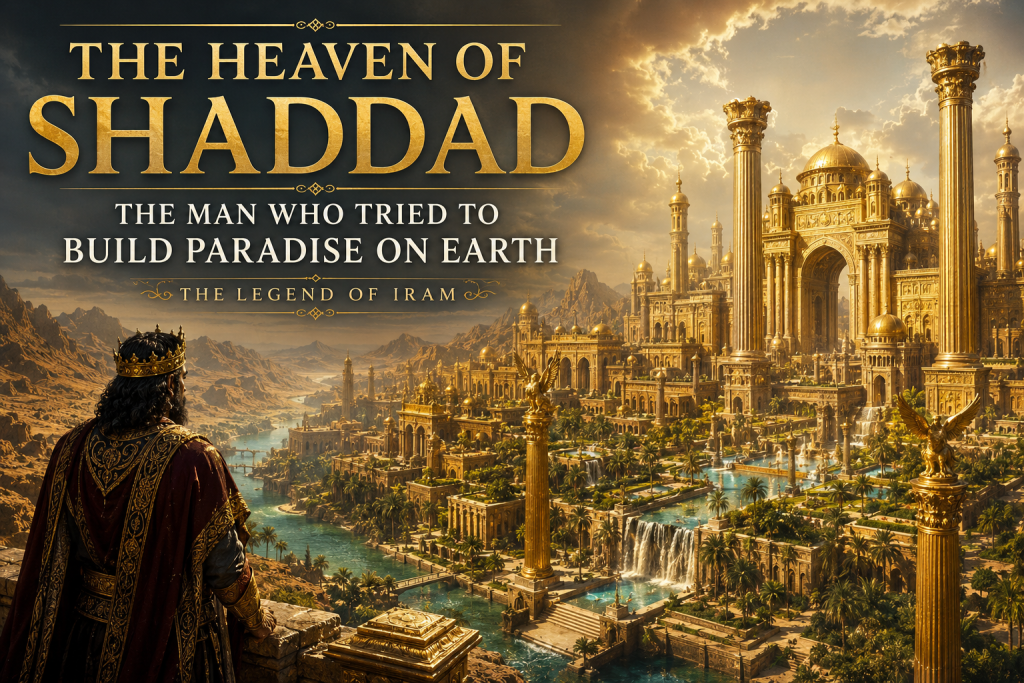
According to a famous Islamic-era legend, this ruler was Shaddad, a powerful king associated with the ancient people of ‘Ad. Determined to create his own paradise on Earth, Shaddad allegedly ordered the construction of a magnificent city filled with golden buildings, precious stones, beautiful gardens, flowing rivers, and extraordinary architecture.
The city became known in later tradition as Iram, often described as Iram of the Pillars.
But the story has a dramatic ending.
Before Shaddad could enjoy his earthly paradise, divine punishment allegedly destroyed the city and its inhabitants. The magnificent kingdom disappeared, leaving behind one of the most fascinating legends associated with ancient Arabia.
Was Iram a real city?
Was Shaddad a historical king?
Was the story inspired by a real ancient civilization?
Or is the tale primarily a moral and theological story about human pride?
The answers remain debated.
This article explores the Heaven of Shaddad, the legend of Iram, the people of ‘Ad, its connection with the Qur’an, and the historical search for the mysterious city.
Who Was Shaddad?
Shaddad is traditionally described in Islamic literature as a powerful ruler connected with the ancient people of ‘Ad.
The story portrays him as a king of enormous wealth and authority. He supposedly ruled over a prosperous civilization in ancient Arabia and became obsessed with surpassing the achievements of other rulers. According to later narratives, Shaddad heard descriptions of the heavenly paradise promised to righteous believers. Instead of accepting paradise as a divine reward in the afterlife, he supposedly decided to create his own paradise on Earth. This ambition became the foundation of the legend of Iram.
It is important to make one distinction clear:
The Qur’an does not explicitly name Shaddad as the builder of Iram.
The detailed story of Shaddad’s earthly paradise comes primarily from later Islamic storytelling, historical literature, and tafsir traditions rather than from a direct Qur’anic account.
That distinction is important when separating religious scripture from later legendary traditions.
The People of ‘Ad
To understand the story of Shaddad, we first need to understand the people of ‘Ad. The Qur’an mentions the people of ‘Ad several times. They are presented as an ancient nation known for their strength and prosperity. They were associated with the prophet Hud, who called them to worship God and abandon arrogance and wrongdoing. The people of ‘Ad, however, rejected Hud’s warning.
They believed their power made them virtually unstoppable.
Their attitude is summarized dramatically in the Qur’anic narrative: they questioned who could possibly be stronger than them.
Their story ultimately became a warning about the consequences of arrogance, oppression, and rejection of divine guidance.
The Qur’an says that a devastating wind was sent against them.
Their destruction became one of the major examples of a powerful civilization brought down because of its arrogance.
What Was Iram?
One of the most mysterious names associated with the story is Iram.
The Qur’an refers to:
“Iram, possessor of the pillars”
The expression appears in Surah Al-Fajr (89:6–8) in the context of the people of ‘Ad. The passage describes Iram as something remarkable, associated with pillars and unmatched in the land. This brief reference has inspired centuries of interpretation.
Was Iram:
- A city?
- A tribe?
- A region?
- A dynasty?
- A monumental architectural center?
- Or a symbolic description of the civilization of ‘Ad?
Scholars have debated these possibilities for centuries.
The popular image of Iram as a gigantic golden city comes largely from later storytelling.
The Dream of Building Paradise on Earth
According to the famous legend, Shaddad became fascinated by descriptions of heaven. He imagined gardens filled with:
- flowing rivers,
- magnificent palaces,
- precious stones,
- beautiful trees,
- fragrant flowers,
- golden structures,
- luxurious surroundings.
Shaddad reportedly decided that if heaven was described as the ultimate place of beauty, he could build something similar on Earth. His ambition was extraordinary. He wanted people to look at his creation and believe that no paradise could be greater. This was not merely an architectural project. It was an expression of absolute pride. Shaddad wanted to prove that human wealth and power could reproduce the ultimate divine creation.
The Construction of Iram
The legend says Shaddad ordered his architects and workers to search for the perfect location. Once the location was chosen, construction supposedly began. According to later accounts, Shaddad commanded his workers to build an enormous city surrounded by magnificent walls.
The city was allegedly decorated with:
- gold,
- silver,
- jewels,
- marble,
- precious stones,
- enormous columns,
- gardens,
- fountains,
- artificial rivers.
Trees were planted throughout the city.
Water channels were constructed to keep the gardens green. Palaces were built with extraordinary architectural detail. The objective was simple:
Create a paradise that would exist entirely under human control.
Why Was It Called the Heaven of Shaddad?
The phrase “Heaven of Shaddad” is a popular description rather than a Qur’anic title. It comes from the idea that Shaddad attempted to reproduce paradise on Earth. The city was supposedly so beautiful that it became known as an earthly heaven. But there was a fundamental difference between Shaddad’s creation and actual paradise. According to the theological message of the story, paradise belongs to God. Human beings can construct magnificent buildings, cities, and gardens, but they cannot create divine paradise through wealth and power. That contrast forms the heart of the legend.
The Final Journey of Shaddad
After the city had supposedly been completed, Shaddad prepared to enter his earthly paradise. He gathered his army and followers and traveled toward the magnificent city. According to some versions of the story, he had never seen anything like it. But something unexpected happened.
Before Shaddad could fully enter and enjoy his creation, divine punishment arrived. The legendary city disappeared. Shaddad and his followers were destroyed. His magnificent paradise, despite all its wealth and effort, could not save him. The story therefore ends with a powerful reversal:
The man who wanted immortality discovered that wealth could not protect him from death.
The Divine Punishment
The destruction of ‘Ad is described in the Qur’an as being associated with a powerful and destructive wind. The Qur’an describes a devastating wind that continued for several days. The people who once believed themselves powerful were destroyed. Their strength, wealth, buildings, and social status could not protect them. This is one of the most important themes of the story of ‘Ad:
Human power is temporary.
Civilizations rise.
Kings become powerful.
Cities become wealthy.
Monuments are constructed.
But none of these things guarantee permanence.
Shaddad and the Lesson of Arrogance
The story of Shaddad is ultimately more than an ancient mystery.
It is a story about human arrogance.
Shaddad represents the ruler who believes that wealth and power make him independent of God.
His ambition begins with admiration for paradise but eventually becomes an attempt to compete with divine creation.
This is why the story has remained powerful for generations.
It asks a timeless question:
How far can human ambition go before it becomes arrogance?
Modern civilization has built enormous skyscrapers, artificial islands, megacities, luxury resorts, and technological wonders.
In that sense, the story of Shaddad still feels surprisingly relevant.
Human beings continue to attempt things that previous generations considered impossible.
Ambition itself is not necessarily wrong.
The warning lies in believing that power makes us invincible.
Is Shaddad Mentioned in the Qur’an?
This is one of the most important questions surrounding the legend.
The short answer is:
No, the Qur’an does not explicitly mention Shaddad by name.
The Qur’an does mention:
- ‘Ad,
- their strength,
- their prophet Hud,
- their rejection of divine guidance,
- Iram,
- and their eventual destruction.
However, the detailed narrative about a king named Shaddad building an earthly paradise comes from later traditions.
This distinction matters because many popular articles present the entire story as if it appears directly in the Qur’an.
It does not.
The Qur’anic text is much more concise.
Later writers expanded the story and connected Shaddad with Iram.
Iram in Islamic Tradition
Over centuries, Muslim historians, commentators, storytellers, and geographers discussed Iram. Different interpretations emerged. Some traditions treated Iram as a magnificent city. Others interpreted the name in connection with the tribe or lineage of ‘Ad. Still others understood the Qur’anic expression as referring to an ancient people or place characterized by impressive architecture. Because the original Qur’anic reference is brief, later literature played an important role in shaping the popular image of Iram. This is why modern readers should distinguish between:
Qur’anic account → later interpretation → legendary storytelling.
These are not necessarily the same thing.
The Mystery of the Lost City of Iram
For centuries, explorers and historians have wondered whether the legendary Iram corresponded to a real archaeological site. The idea of a lost city buried beneath the Arabian desert captured the imagination of the world. The legend became especially popular in modern books, documentaries, and archaeological discussions. One candidate that has frequently been associated with Iram is Shisr, an archaeological site in Oman.
The site became associated with the legendary city after archaeological and satellite investigations revealed evidence of an ancient settlement and trade activity. However, identifying Shisr with the exact Iram described in later legends remains controversial. There is no universally accepted archaeological proof that Shisr was the literal city of Shaddad.
The Search for Iram
Modern technology changed the search. Satellite imagery allowed researchers to examine enormous areas of the Arabian Peninsula that would have been difficult to explore from the ground. Ancient caravan routes became easier to trace. Archaeologists discovered evidence of settlements, wells, roads, and trading networks beneath or around desert landscapes. These discoveries demonstrated something important:
Ancient Arabia was far more connected and economically sophisticated than many people once assumed.
Incense routes crossed large areas of Arabia. Cities and settlements depended on water sources. Trade connected southern Arabia with regions farther north. This historical reality provides an interesting background for the legend of Iram. But it does not automatically prove that Shaddad’s paradise existed exactly as described in later stories.
The Lost City and the Desert
The Arabian Peninsula contains vast deserts capable of concealing traces of ancient human settlement. Sand can cover roads, walls, wells, and archaeological remains. Some settlements may have disappeared because of:
- changing climate,
- drought,
- shifting trade routes,
- water shortages,
- political instability,
- abandonment,
- natural disasters.
Therefore, the concept of a “lost city” in Arabia is not inherently impossible.
Ancient settlements really did disappear.
But the specific claim that one of them was Shaddad’s Iram remains unproven.
Iram: Myth or Historical Reality?
This is perhaps the most fascinating question. There are several possibilities.
1. Iram Was a Real Place
Some researchers believe the Qur’anic reference may preserve memory of a real ancient place or civilization. If so, archaeological research may eventually reveal more about the people associated with ‘Ad. However, this does not necessarily validate every detail of the Shaddad legend.
2. Iram Was a Tribal or Dynastic Name
Another interpretation is that Iram referred to a lineage, tribe, or political group rather than a single city. Under this interpretation, “Iram of the pillars” may describe a powerful society rather than a giant paradise city.
3. The Story Became Expanded Through Folklore
Another possibility is that later storytellers expanded the relatively brief Qur’anic account into a dramatic narrative. Over generations, the story accumulated details about:
- Shaddad,
- his wealth,
- his architects,
- his palace,
- his gardens,
- his desire to imitate heaven,
- and the destruction of his city.
This process is common in folklore.
A short historical or religious reference can develop into an elaborate legend.
The Seven Wonders of Shaddad’s Paradise
Popular versions of the legend often describe Iram in almost supernatural terms. Although details vary between sources, the imagined city commonly includes:
Golden Palaces
Buildings were supposedly decorated with gold and precious materials.
Huge Columns
The phrase “Iram of the Pillars” encouraged the image of enormous columns supporting magnificent buildings.
Artificial Rivers
Water was supposedly brought through channels to maintain gardens in the desert.
Exotic Gardens
The city allegedly contained lush vegetation despite its desert surroundings.
Precious Stones
Jewels and rare stones supposedly decorated buildings and pathways.
Magnificent Gates
Massive entrances were said to mark the boundary between the ordinary world and Shaddad’s artificial paradise.
Endless Luxury
Everything was designed to imitate the beauty and abundance associated with heaven.
Whether these details represent historical reality or later imagination is impossible to establish from the legend alone.
Why Would Shaddad Want to Challenge Heaven?
The theological meaning of the story provides an answer.
Shaddad’s ambition was not simply to build a beautiful city. He wanted to demonstrate that human beings could create something comparable to paradise. This represents a classic theme found across many cultures:
The danger of attempting to become greater than one’s natural limits.
Similar themes appear in stories about rulers, builders, conquerors, and civilizations who believe their achievements make them immortal.
The lesson is not that architecture or wealth is evil.
Rather, the story warns against arrogance and the illusion of absolute power.
Shaddad’s Paradise and Modern Megacities
Interestingly, the legend has parallels with the modern world. Today, governments and wealthy individuals invest enormous amounts in creating futuristic cities.
We see:
- skyscrapers rising hundreds of meters,
- artificial islands,
- desert cities,
- luxury developments,
- smart cities,
- climate-controlled environments,
- artificial forests,
- enormous entertainment complexes.
These projects are technological achievements. But they also raise an old philosophical question:
Can human beings engineer paradise?
Shaddad’s story suggests that paradise is not simply a matter of architecture. A beautiful environment cannot guarantee happiness, morality, justice, or immortality.
The Psychological Meaning of the Story
The legend can also be understood psychologically. Shaddad represents the human desire to control everything.
He wants to control:
- nature,
- wealth,
- beauty,
- society,
- death,
- and even the concept of paradise.
- But death remains beyond his control.
- This makes the story particularly powerful.
- The city represents human achievement.
- Its destruction represents human limitation.
- The king represents ambition.
- His downfall represents arrogance.
Iram and the Power of Storytelling
Why has the story survived for so long? Because it combines several elements that naturally attract human imagination.
There is:
- a mysterious king,
- an ancient civilization,
- unimaginable wealth,
- a lost city,
- a desert mystery,
- divine punishment,
- archaeological speculation,
- and a moral lesson.
Few stories combine history, religion, archaeology, and mystery so effectively.
Even people who do not accept the literal story can appreciate its cultural significance.
The Archaeological Debate
Archaeologists generally approach the Iram question cautiously. Finding an ancient settlement in Arabia does not automatically establish that it was Iram. To make a strong historical identification, researchers would ideally need evidence such as:
- inscriptions,
- contemporary written records,
- identifiable rulers,
- chronological evidence,
- cultural connections,
- architectural evidence,
- and independent historical confirmation.
So far, no archaeological discovery has universally established:
“This is the exact city of Shaddad described in the legends.”
Therefore, claims that archaeology has definitively discovered Shaddad’s paradise should be treated with caution.
What Happened to the People of ‘Ad?
According to the Qur’anic narrative, the people of ‘Ad were destroyed after rejecting the message of Prophet Hud. Their destruction is associated with a powerful wind. The story emphasizes the contrast between their former strength and their ultimate helplessness. A civilization that considered itself powerful was reduced to ruins and memory.
This is why the story of ‘Ad is repeatedly used in Islamic teachings as an example of what happens when power is combined with arrogance.
The Moral of the Heaven of Shaddad
The central lesson can be summarized simply:
- Wealth cannot defeat death.
- Architecture cannot guarantee immortality.
- Power cannot make a human being divine.
- Luxury cannot replace spiritual fulfillment.
- Human civilization remains vulnerable.
Shaddad supposedly built paradise because he believed material achievement could satisfy the deepest human desire.
But the legend ends by showing that material power has limits.
Frequently Asked Questions About Shaddad and Iram
Was Shaddad a real historical king?
There is no universally accepted historical evidence establishing Shaddad as the king described in the popular legend.
His story belongs primarily to later Islamic literary and interpretive traditions.
Did Shaddad really build paradise?
There is no conclusive archaeological evidence proving that Shaddad built a literal paradise on Earth.
The famous description of his city comes mainly from later storytelling.
Is Iram mentioned in the Qur’an?
Yes. Iram is mentioned in Surah Al-Fajr, verses 6–8, in connection with the people of ‘Ad.
However, the Qur’an does not provide the detailed story of Shaddad building a paradise.
Did Shaddad build Iram?
This is a popular traditional claim, but it is not explicitly stated in the Qur’an. The association developed through later Islamic literature.
Where was Iram located?
The exact location remains uncertain. Various theories have connected Iram with different locations in the Arabian Peninsula, including areas of Oman. No location has been universally accepted as the historical Iram.
Was Iram made of gold?
Later legends describe an extraordinarily wealthy city decorated with gold, precious stones, and magnificent architecture. There is no archaeological evidence establishing that a city literally made of gold existed.
Was Iram destroyed by a sandstorm?
The Qur’anic account describes the destruction of ‘Ad through a powerful wind. Popular versions of the legend sometimes portray the city as being swallowed or buried by the desert. These details should not be confused with the precise Qur’anic account.
Is Iram the same as Atlantis?
Not exactly. Atlantis is a separate legendary tradition originating in the works of the ancient Greek philosopher Plato. Iram belongs to Arabian and Islamic religious-literary traditions. Both involve ideas of powerful civilizations that disappeared, but they have different origins and narratives.
The Enduring Mystery of Shaddad
The legend of Shaddad continues to fascinate people because it stands at the intersection of faith, history, archaeology, and mythology. Perhaps a real ancient civilization lies behind some elements of the tradition. Perhaps Iram was a historical place whose memory became legendary. Perhaps the story developed primarily as a moral narrative. Or perhaps several different historical memories were combined over centuries. We may never know exactly how much of the story reflects historical events. But the mystery itself has become part of the legacy of Iram.
Final Thoughts: The Paradise That Could Not Save Its King
The story of the Heaven of Shaddad is ultimately not just about a lost city. It is about the limits of human power. Shaddad allegedly possessed wealth beyond imagination. He commanded armies, controlled resources, and ordered the construction of an extraordinary city. Yet none of it could guarantee his survival. That is the paradox at the heart of the legend. A man tried to build heaven on Earth—but could not escape the fate of every human being.
Whether Iram was a real city, a memory of an ancient civilization, or a legendary creation, its story has survived for centuries because its message remains relevant. Human beings can build extraordinary things. We can transform deserts into cities, cross oceans, reach space, and create technologies that previous generations could barely imagine. But the ancient lesson remains:
The greatest monuments eventually become ruins, and human power is never absolute.
Perhaps that is the real meaning behind the mysterious Heaven of Shaddad. Not that a king once built a paradise. But that even the greatest human achievements cannot make us masters of destiny. And somewhere beneath the sands of Arabia—or perhaps only within the pages of history and legend—the name Iram continues to remind us of that truth.
Key Takeaways
- Shaddad is traditionally associated with the ancient people of ‘Ad.
- The popular story says he attempted to build an earthly paradise called Iram.
- The detailed story of Shaddad’s paradise comes primarily from later Islamic traditions, not directly from the Qur’an.
- The Qur’an mentions Iram of the Pillars in Surah Al-Fajr.
- The people of ‘Ad are associated with Prophet Hud and are described as being destroyed by a powerful wind.
- Archaeological discoveries in Arabia have encouraged discussion about ancient settlements that may relate to the Iram tradition.
- No archaeological discovery has conclusively proven that a literal golden city built by Shaddad has been found.
- The enduring message of the story concerns arrogance, mortality, wealth, and the limits of human power.