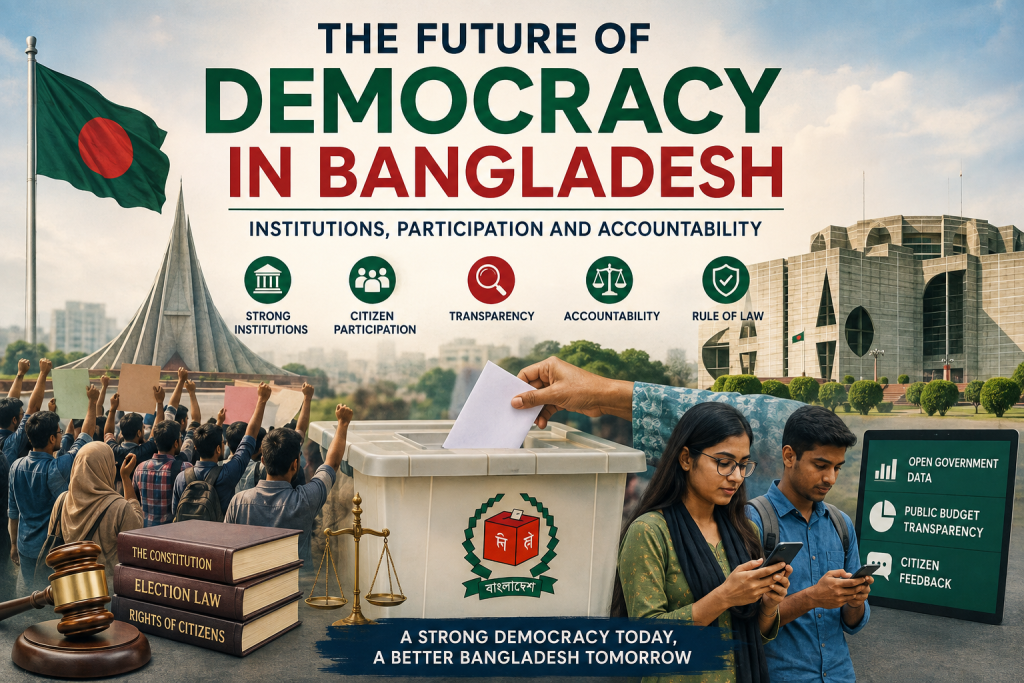
The Future of Democracy in Bangladesh: Institutions, Participation and Accountability
Introduction
The future of democracy in Bangladesh will depend on more than the holding of elections. It will depend on whether democratic institutions can operate independently, whether political competition becomes more inclusive, whether citizens can participate meaningfully, and whether governments can be held accountable for their decisions.
Bangladesh has entered a particularly important phase of its political development following the upheaval of 2024, the interim administration, the February 2026 parliamentary election and referendum, and the continuing debate over constitutional and institutional reforms. The Commonwealth Observer Group described the February 2026 election as peaceful, orderly and transparent overall, while also identifying areas requiring further improvement, including institutional trust, women’s and youth participation, media freedom and digital integrity.
The country’s democratic future is therefore neither predetermined nor reducible to one political party or election. It will depend on whether reforms become durable institutions rather than temporary political arrangements.
This article examines the future of democracy in Bangladesh from a nonpartisan perspective, focusing on five interconnected questions:
- Can democratic institutions become more independent?
- Can political competition become more open and peaceful?
- Can citizens participate beyond election day?
- Can transparency and accountability become routine?
- Can constitutional and institutional reforms survive changes of government?
What Does the Future of Democracy in Bangladesh Mean?
Democracy is often understood primarily as the right to vote and elect representatives. Elections are certainly fundamental, but a functioning democracy requires much more.
A durable democratic system generally depends on:
- credible elections;
- an independent election management body;
- an effective parliament;
- an independent judiciary;
- freedom of expression and media;
- political pluralism;
- civil society participation;
- transparent public administration;
- mechanisms to investigate corruption;
- peaceful transfer of political power;
- protection of fundamental rights; and
- accountability for government officials.
The experience of Bangladesh illustrates why these elements must work together.
Freedom House’s 2026 assessment classified Bangladesh as “Partly Free” and highlighted continuing challenges involving political rights, civil liberties, institutional safeguards, due process, corruption controls and freedom of expression. At the same time, it noted the reopening of political and civic space following the 2024 political transition.
This combination is important: democratic development can involve both significant openings and persistent institutional weaknesses.
1. Bangladesh’s Democratic Transition After 2024
The political transformation following the 2024 uprising created an unusual period in Bangladesh’s constitutional and political history.
The interim government led by Muhammad Yunus took office following the departure of Sheikh Hasina’s government and undertook a reform programme covering areas such as elections, constitutional arrangements, public administration, the judiciary, policing and anti-corruption institutions.
The reform process subsequently produced the July National Charter, which brought together numerous proposals concerning Bangladesh’s democratic architecture.
According to the International Republican Institute’s pre-election assessment, the Charter contained 84 proposals covering major aspects of governance and constitutional reform, including possible changes to the legislature, executive power, judicial independence, constitutional appointments and local government.
The February 2026 election and referendum then moved the discussion from transitional reform toward implementation.
This creates one of the central questions for the future:
Can political agreements made during a period of transition become permanent institutions accepted by governments and opposition parties alike?
That question will be more important than any single reform announcement.
2. Democratic Institutions Will Be the Foundation
The strongest indicator of democratic durability is not the popularity of a particular government. It is the strength of institutions that continue functioning regardless of who controls political power.
The Election Commission
A credible Election Commission is essential.
Citizens must have confidence that:
- voter registration is accurate;
- electoral boundaries are administered fairly;
- candidates receive equal legal treatment;
- campaign rules are enforced;
- election officials remain professional;
- counting and results management are transparent; and
- complaints can be resolved independently.
The Commonwealth Observer Group found that the 2026 election was generally conducted professionally, while also noting that skepticism about the Election Commission’s independence and capacity remained because of earlier controversies.
For the future, institutional credibility will depend on more than conducting one election successfully. The Commission must demonstrate consistency across multiple election cycles.
Parliament
A democratic parliament should do more than pass government legislation.
It should:
- scrutinize executive decisions;
- question ministers;
- investigate public expenditure;
- examine legislation;
- provide space for opposition voices;
- oversee government agencies; and
- represent diverse constituencies.
Parliamentary committees are especially important.
If committee chairs, parliamentary investigations and legislative debates become meaningful mechanisms of oversight, parliament can become an effective institutional check on executive authority.
The July Charter includes proposals relating to parliamentary oversight, including opposition participation in certain parliamentary positions.
Whether such provisions ultimately strengthen accountability will depend on their implementation and enforcement.
3. Constitutional Reform and the July National Charter
One of the most important developments in Bangladesh’s democratic debate is the July National Charter.
The Charter emerged from negotiations among political parties and reform discussions following the 2024 political transition. It covers areas including constitutional reform, elections, parliament, judicial independence, public administration, policing, anti-corruption and local government.
The implementation process became particularly significant after the 2026 referendum.
The Implementation Order proposed reforms including:
- a bicameral parliament;
- a 100-member upper chamber based on proportional representation;
- greater parliamentary oversight;
- increased women’s representation;
- possible limits on the prime minister’s tenure;
- changes concerning presidential powers;
- judicial independence;
- stronger local government; and
- reforms to constitutional institutions.
However, implementation has generated legal and political debate.
Reports during 2026 indicated disagreement over whether the reforms should proceed through the ordinary parliamentary constitutional amendment process or through a proposed Constitutional Reform Council.
This debate illustrates a broader democratic principle:
How reforms are adopted can be almost as important as what the reforms contain.
Constitutional change is more likely to endure when it has:
- clear legal authority;
- transparent procedures;
- broad political participation;
- public understanding;
- judicial review where appropriate; and
- mechanisms preventing future governments from selectively ignoring the reforms.
4. Political Competition and the Opposition
Democracy requires meaningful competition.
A political system is stronger when different parties can:
- organize;
- recruit candidates;
- campaign;
- communicate with voters;
- criticize government policy;
- contest elections;
- gain parliamentary representation; and
- potentially form a government.
The February 2026 election represented a major change in Bangladesh’s political environment, with multiple parties and candidates participating. The Commonwealth reported 51 registered political parties and 2,034 candidates in the election.
At the same time, the absence or exclusion of major political actors can affect perceptions of political inclusiveness.
A sustainable democratic system therefore needs rules that are predictable and applied according to law rather than changing according to which party happens to hold power.
Why peaceful political competition matters
Political competition should not mean permanent confrontation.
Healthy competition allows parties to disagree over:
- economic policy;
- taxation;
- employment;
- education;
- healthcare;
- foreign policy;
- social policy;
- decentralization; and
- constitutional reform.
The objective is not to eliminate political disagreement. Democracy needs disagreement.
The institutional challenge is to ensure that disagreement occurs through:
Parliament → elections → courts → public debate → lawful civic participation
rather than through political violence or institutional obstruction.
5. Citizen Participation Must Go Beyond Voting
The future of democracy in Bangladesh will also depend on whether citizens participate between elections.
Democratic participation can include:
- voting;
- attending local government meetings;
- submitting information requests;
- participating in public consultations;
- joining civil society organizations;
- monitoring elections;
- reporting corruption;
- engaging in policy discussions;
- participating in peaceful demonstrations;
- contacting elected representatives; and
- using digital platforms responsibly.
The Commonwealth Observer Group noted that young people played a significant role in the 2024 protests but remained underrepresented in party leadership and as candidates in the 2026 election. It also highlighted the relatively low representation of women among candidates and directly elected MPs.
These findings point to a major opportunity.
Youth Participation
Bangladesh has a large young population.
Young citizens are increasingly active through:
- social media;
- student organizations;
- volunteer networks;
- entrepreneurship;
- civil society;
- online campaigns; and
- community initiatives.
But political participation should not be limited to moments of political crisis.
A stronger democratic future would involve mechanisms through which young people can contribute to policymaking during normal political periods.
Possible approaches include:
- youth parliamentary forums;
- local policy consultations;
- political party leadership development;
- civic education;
- student debate programmes;
- digital public consultation; and
- youth representation in local government.
6. Women’s Political Participation
Women’s participation remains another important measure of democratic inclusion.
The Commonwealth reported that women accounted for roughly half of Bangladesh’s population but only about 4% of constituency candidates in the 2026 election, while seven women were directly elected to constituency seats. The country also has constitutionally reserved parliamentary seats for women.
The challenge is therefore not simply whether women have formal political rights.
It is whether women can realistically:
- become candidates;
- campaign safely;
- lead political organizations;
- participate in local politics;
- influence party decisions; and
- compete for directly elected seats.
Democratic participation becomes deeper when representation extends from formal rights to practical opportunities.
7. Transparency: Citizens Need to Know How Government Works
Transparency is a prerequisite for accountability.
Citizens cannot effectively evaluate government performance if they cannot determine:
- how public money is spent;
- why contracts are awarded;
- how policies are developed;
- who owns companies receiving government contracts;
- how officials are appointed;
- how regulations are enforced; and
- how major government decisions are made.
Transparency should therefore extend beyond publishing occasional documents.
A modern democratic administration should make public information accessible, understandable and searchable.
Digital transparency
Bangladesh can potentially make significant progress through digital government systems.
Examples include:
- online procurement information;
- public budget dashboards;
- government expenditure databases;
- searchable parliamentary records;
- digital land records;
- open datasets;
- online freedom-of-information systems; and
- publicly accessible court information.
Technology cannot replace institutional integrity, but it can make government activity easier to monitor.
8. Accountability and Anti-Corruption
Accountability is one of the most important elements of the future of democracy in Bangladesh.
A government becomes more accountable when officials know that unlawful or corrupt conduct can lead to investigation and legal consequences regardless of political affiliation.
Accountability mechanisms can include:
- Anti-Corruption Commission investigations;
- parliamentary oversight;
- judicial review;
- independent audits;
- media investigations;
- public procurement monitoring;
- asset declarations;
- financial disclosure requirements; and
- citizen complaints.
But accountability must also respect due process.
A democratic anti-corruption system should not become a tool for political retaliation.
This distinction is especially important during political transitions.
Human Rights Watch has warned that accountability for abuses should not be replaced by mass criminal complaints or politically motivated retaliation, emphasizing the importance of evidence, due process and institutional safeguards.
Therefore:
Accountability + due process = sustainable democratic justice
9. Judicial Independence
No democratic system can remain stable if citizens believe courts are politically controlled.
Judicial independence requires safeguards concerning:
- judicial appointments;
- tenure;
- transfers;
- disciplinary procedures;
- court administration;
- access to justice; and
- protection from political pressure.
The reform debate in Bangladesh has included proposals aimed at strengthening judicial independence and changing institutional appointment arrangements.
For citizens, the practical question is simple:
Can an ordinary person challenge the government in court and receive a fair hearing?
If the answer becomes consistently yes, democratic institutions become more credible.
10. Freedom of the Press and Digital Democracy
A democratic society needs independent journalism.
The media performs several important functions:
- informs voters;
- investigates corruption;
- scrutinizes government policy;
- provides a platform for competing political arguments;
- exposes abuses; and
- helps citizens make informed decisions.
The Commonwealth Observer Group described Bangladesh’s media environment during the 2026 campaign as more open than in previous electoral cycles, but also noted continuing concerns involving attacks on media organizations and legal restrictions affecting journalists.
Digital platforms have further transformed political participation.
Facebook, YouTube, TikTok, WhatsApp and X have become major spaces for political discussion.
But digital democracy brings risks:
- misinformation;
- manipulated videos;
- coordinated disinformation;
- harassment;
- political intimidation;
- deepfakes; and
- rapid circulation of unverified claims.
The answer should not automatically be greater censorship.
A more sustainable approach combines:
media literacy + fact-checking + independent journalism + transparent platform rules + legal safeguards for legitimate expression.
11. Local Government and Democratic Decentralization
Democracy is not only a national phenomenon.
For many Bangladeshis, the most important government institutions are local:
- Union Parishads;
- Upazila Parishads;
- municipalities;
- city corporations; and
- district-level administrative structures.
Citizens experience democracy through practical services such as:
- roads;
- sanitation;
- water;
- waste management;
- local education;
- healthcare;
- social safety programmes; and
- community infrastructure.
Stronger local government can make democracy more tangible.
If local representatives have meaningful authority, predictable budgets and accountability mechanisms, citizens can directly observe how democratic institutions affect everyday life.
The July Charter also includes stronger local-government arrangements among its reform themes.
12. Political Parties Must Also Become Democratic Institutions
Democratic institutions are not limited to government agencies.
Political parties themselves are critical democratic institutions.
Parties can strengthen democracy through:
- transparent leadership selection;
- internal elections;
- financial disclosure;
- candidate selection procedures;
- women’s participation;
- youth leadership;
- policy-based campaigning; and
- internal mechanisms for resolving disputes.
If political parties remain highly centralized, parliamentary democracy can become overly dependent on individual leaders.
A healthier system would encourage political organizations to develop institutional leadership rather than relying entirely on personalities.
13. The Role of Civil Society
Civil society can provide an important bridge between citizens and government.
Organizations working on:
- human rights;
- education;
- environment;
- women’s rights;
- disability rights;
- governance;
- anti-corruption;
- consumer rights; and
- community development
can help identify problems that political institutions sometimes overlook.
Election observers are another important part of civil society.
The International Republican Institute reported that domestic election observation expanded in principle before the 2026 election, while also identifying capacity differences among observer organizations.
A strong democratic system benefits when civil society can operate independently and lawfully without being treated automatically as either an opponent or supporter of the government.
14. Democracy and Economic Development
Political institutions and economic development are closely connected.
Citizens are more likely to trust institutions when they experience:
- stable employment;
- predictable regulations;
- fair taxation;
- reliable public services;
- economic opportunity;
- protection of property rights; and
- fair access to government services.
At the same time, economic growth alone does not guarantee democracy.
A country can experience economic development while institutions remain weak.
The long-term objective should therefore be both institutional and economic resilience.
Transparent public procurement, predictable regulation and effective anti-corruption institutions can help connect democratic accountability with economic performance.
15. The Major Challenges Ahead
The future of democracy in Bangladesh will face several continuing challenges.
Political polarization
Deep political divisions can make compromise difficult.
Democratic systems require opposition parties to disagree without treating every disagreement as a threat to the state.
Institutional politicization
When public institutions become associated with a particular political party, citizens may question their neutrality.
Future governments therefore face an important test: whether they are willing to preserve institutional independence even when it limits their own political power.
Political violence
Violence undermines political competition.
Candidates, journalists, activists and ordinary citizens need an environment where political disagreement does not create a risk of physical retaliation.
Misinformation
Digital misinformation can distort political debate.
Bangladesh will need stronger media literacy and independent fact-checking capacity while protecting legitimate political expression.
Unequal political participation
Women, young people, minorities, persons with disabilities and marginalized communities need meaningful opportunities to participate.
The 2026 election demonstrated both progress and continuing gaps in electoral inclusion, including innovations such as braille ballots alongside persistent representation challenges.
16. What Could Strengthen Bangladesh’s Democratic Future?
A practical democratic reform agenda could focus on several areas.
1. Strengthen election administration
The Election Commission should have sufficient independence, professional capacity and transparent procedures.
2. Strengthen parliamentary oversight
Parliamentary committees should receive adequate resources and authority to scrutinize executive actions.
3. Protect judicial independence
Judicial appointments and disciplinary mechanisms should be transparent and institutionally protected.
4. Improve political party democracy
Parties should increase internal participation, financial transparency and opportunities for women and younger leaders.
5. Expand citizen participation
Public consultations, local government engagement and digital participation can give citizens more influence between elections.
6. Strengthen anti-corruption institutions
Anti-corruption enforcement should be evidence-based and independent of political affiliation.
7. Improve transparency
Government contracts, spending, appointments and policy decisions should be increasingly accessible to citizens.
8. Protect media freedom
Journalists should be able to investigate government and opposition actors without political retaliation.
9. Develop digital civic literacy
Citizens need the tools to distinguish credible information from manipulated or misleading content.
10. Build institutional continuity
Reforms should be designed so that future governments cannot easily reverse democratic safeguards for short-term political advantage.
17. Three Possible Dimensions of Bangladesh’s Democratic Future
Rather than predicting one specific political outcome, it is useful to think about three institutional dimensions.
Scenario A: Institutional consolidation
In this direction, reforms become embedded in law and practice.
Political parties accept electoral competition, parliament becomes stronger, courts maintain independence, and government institutions operate with greater transparency.
The result would be a democracy increasingly based on institutions rather than personalities.
Scenario B: Electoral democracy with weak checks
Another possibility is that elections remain competitive but other institutions remain vulnerable.
Political parties may compete effectively while:
- executive power remains highly concentrated;
- oversight institutions remain weak;
- political appointments remain extensive; and
- accountability mechanisms remain inconsistent.
This would provide electoral competition without fully resolving institutional weaknesses.
Scenario C: Renewed political confrontation
A third possibility would involve continued polarization, institutional disputes and political conflict.
If political parties view institutions primarily as instruments for gaining or maintaining power, reforms may become temporary and democratic trust may weaken.
These scenarios are not predictions. They illustrate why institutional design and political behavior both matter.
18. Why Accountability Must Apply to Everyone
One of the most important lessons for Bangladesh’s democratic future is that accountability cannot depend on political identity.
A credible democratic system should be capable of investigating:
- government officials;
- opposition politicians;
- former officials;
- security personnel;
- business interests;
- political activists; and
- anyone else suspected of unlawful conduct.
The same legal standards should apply regardless of party affiliation.
This is particularly important after periods of political upheaval.
If accountability becomes perceived as selective punishment of political opponents, public confidence can decline.
If accountability is transparent, evidence-based and subject to due process, it can strengthen trust in democratic institutions.
19. The Importance of Peaceful Transfer of Power
One of democracy’s greatest tests comes after an election.
The losing side must be able to accept the result through lawful mechanisms.
The winning side must recognize that electoral victory does not provide unlimited authority.
A government elected by voters still operates under:
- the Constitution;
- legislation;
- judicial review;
- parliamentary scrutiny;
- financial oversight;
- media scrutiny; and
- public criticism.
Likewise, an opposition party should be able to challenge government policy without attempting to undermine the constitutional system.
This balance is essential to democratic stability.
20. Technology Could Transform Democratic Participation
Bangladesh has an opportunity to use technology to make government more accessible.
Future democratic innovations could include:
Digital public consultations
Citizens could provide feedback on proposed policies and legislation.
Open government data
Government datasets could allow journalists, researchers and citizens to examine public spending and service delivery.
Online parliamentary information
Citizens could easily access:
- bills;
- committee reports;
- voting records;
- parliamentary questions; and
- legislative debates.
Digital complaint systems
Citizens could track the status of complaints submitted to government agencies.
Technology should not replace democratic institutions. Instead, it can make them more accessible.
21. What Citizens Can Do
The future of democracy is not solely the responsibility of politicians.
Citizens also play an important role.
Individuals can contribute by:
- voting;
- checking information before sharing it;
- participating peacefully in civic activities;
- following parliamentary proceedings;
- asking representatives questions;
- reporting corruption through lawful channels;
- supporting credible journalism;
- learning about constitutional rights;
- respecting political disagreement; and
- evaluating candidates based on policies and records rather than rumors.
Democracy becomes stronger when citizens remain engaged between elections.
22. A Democratic Culture Is as Important as Democratic Institutions
Laws can establish institutions.
They cannot automatically create democratic culture.
A democratic political culture requires acceptance of several principles:
Opposition is legitimate.
Criticism is not treason.
Election winners have responsibilities as well as powers.
Minorities have rights even when they lose elections.
Governments can be criticized.
Courts can review government decisions.
Journalists can investigate powerful people.
Citizens can peacefully disagree.
These principles help turn constitutional democracy into everyday political practice.
23. Bangladesh’s Democratic Future: Key Indicators to Watch
Over the next several years, observers and citizens can evaluate democratic development through measurable indicators.
| Area | Questions to Watch |
|---|---|
| Elections | Are elections competitive, transparent and professionally administered? |
| Election Commission | Does it operate independently and consistently? |
| Parliament | Does parliament effectively scrutinize government? |
| Judiciary | Can courts operate independently? |
| Media | Can journalists investigate powerful actors? |
| Political parties | Are internal processes becoming more democratic? |
| Women | Is women’s direct political representation increasing? |
| Youth | Are younger citizens gaining meaningful political opportunities? |
| Local government | Are local institutions receiving meaningful authority? |
| Transparency | Can citizens access government information? |
| Anti-corruption | Are investigations independent and evidence-based? |
| Civil society | Can organizations operate without undue political pressure? |
| Digital space | Can citizens participate online while misinformation is addressed proportionately? |
| Political violence | Are political disputes increasingly resolved through institutions rather than force? |
These indicators provide a more useful framework than judging democracy solely by whether a particular party wins an election.
24. The Central Question: Can Institutions Survive Political Change?
Perhaps the most important question for the future of democracy in Bangladesh is this:
Will democratic institutions remain strong when political power changes hands?
An institution is truly independent when it can constrain the government that created, appointed or funds it.
An Election Commission should be able to challenge the governing party.
A parliament should be able to investigate the executive.
A court should be able to rule against the government.
A newspaper should be able to criticize those in power.
An anti-corruption body should be able to investigate politically influential individuals.
And an opposition party should be able to compete without fearing institutional retaliation.
This is the essence of institutional democracy.
Conclusion
The future of democracy in Bangladesh will ultimately be determined by the interaction between institutions, political parties, citizens and the rule of law.
The country’s recent political transition created an opportunity for significant institutional reform. The 2026 parliamentary election and referendum moved Bangladesh into a new phase in which the central challenge is no longer simply whether reform should occur, but how reforms will be implemented, interpreted and sustained. The Commonwealth’s assessment identified the 2026 election as a significant democratic milestone while also highlighting continuing challenges involving trust, inclusion, media freedom, youth participation and institutional safeguards.
The July National Charter has added another important dimension to this debate. Its proposals cover major aspects of Bangladesh’s constitutional and institutional structure, but implementation has itself generated questions about procedure, legal authority and political consensus.
The long-term success of Bangladesh’s democracy will therefore depend less on individual political personalities and more on whether institutions become resilient enough to withstand political change.
A durable democratic Bangladesh would be one where:
- elections are credible;
- political competition is peaceful;
- parliament exercises meaningful oversight;
- courts remain independent;
- citizens participate beyond election day;
- women and young people have greater opportunities;
- journalists can investigate freely;
- government information is accessible;
- corruption investigations follow evidence and due process; and
- constitutional rules apply equally to those in power and those outside it.
Democracy is not a finished destination. It is an institutional process that must be maintained through every election, every parliament, every government and every generation.
For Bangladesh, the next chapter will be determined not simply by who governs, but by how power is exercised, how institutions respond, and how effectively citizens can hold those institutions accountable.
Frequently Asked Questions (FAQ)
What is the future of democracy in Bangladesh?
The future of democracy in Bangladesh will depend on the strength and independence of democratic institutions, political competition, citizen participation, transparency, accountability, media freedom and the rule of law.
Why are democratic institutions important in Bangladesh?
Institutions such as parliament, the Election Commission, judiciary, anti-corruption bodies and local governments create checks on political power and help ensure that democratic rules continue to operate regardless of which party is governing.
What was the July National Charter?
The July National Charter is a political reform framework developed after Bangladesh’s 2024 political transition. It contains proposals covering constitutional reform, elections, parliament, judicial independence, public administration, anti-corruption, policing and local government.
Why is political competition important?
Political competition gives citizens meaningful choices and allows opposition parties to challenge government policies and potentially gain power through elections.
How can citizens strengthen democracy?
Citizens can vote, participate in civic activities, monitor government performance, support credible journalism, verify information before sharing it, engage with elected representatives and peacefully participate in public debate.
What role do young people have in Bangladesh’s democracy?
Young people can participate as voters, candidates, activists, journalists, researchers, entrepreneurs and civil society leaders. Expanding their representation in political organizations and elected institutions can broaden democratic participation.
How important is women’s participation?
Women’s participation is essential for inclusive representation. The 2026 election demonstrated that formal representation mechanisms coexist with continuing gaps in women’s direct electoral participation.
Can technology improve democracy in Bangladesh?
Yes. Digital platforms can improve access to government information, parliamentary records, public consultations, election information and complaint systems. However, digital democracy also requires safeguards against misinformation, harassment and manipulation.
What is the biggest challenge for Bangladesh’s democracy?
There is no single challenge. Institutional independence, political polarization, political violence, accountability, media freedom, inclusion and public trust are interconnected challenges.
Will constitutional reforms automatically strengthen democracy?
Not necessarily. The effectiveness of constitutional reform depends on the legal process used to adopt it, institutional implementation, political acceptance and whether future governments respect the resulting rules.