Awami League Governments Since 1996: A Comparative Historical Overview
Historical note: This article is a comparative overview rather than an endorsement or criticism of any political party. It separates documented developments from contested political interpretations and focuses on the periods in which the Awami League formed the national government.
Introduction
The history of the Awami League governments in Bangladesh since 1996 can be divided into two major eras: the first Sheikh Hasina-led government from 1996 to 2001, and the much longer period beginning in 2009 and ending in 2024. Between these periods, Bangladesh was governed by the BNP from 2001 to 2006, followed by a military-backed caretaker government during 2007–2008.
The two Awami League eras were very different.
The 1996–2001 government operated in a competitive parliamentary environment in which the newly established caretaker-government system had helped produce the election that brought the party to power. Its agenda included diplomatic agreements, peace-building, rural development, social protection and food security.
The 2009–2024 period, by contrast, was marked by a much longer period of uninterrupted Awami League rule. It began after the December 2008 election, widely regarded as a competitive election, and subsequently included the controversial elections of 2014, 2018 and 2024. International IDEA notes that concerns about electoral integrity increased substantially after 2014.
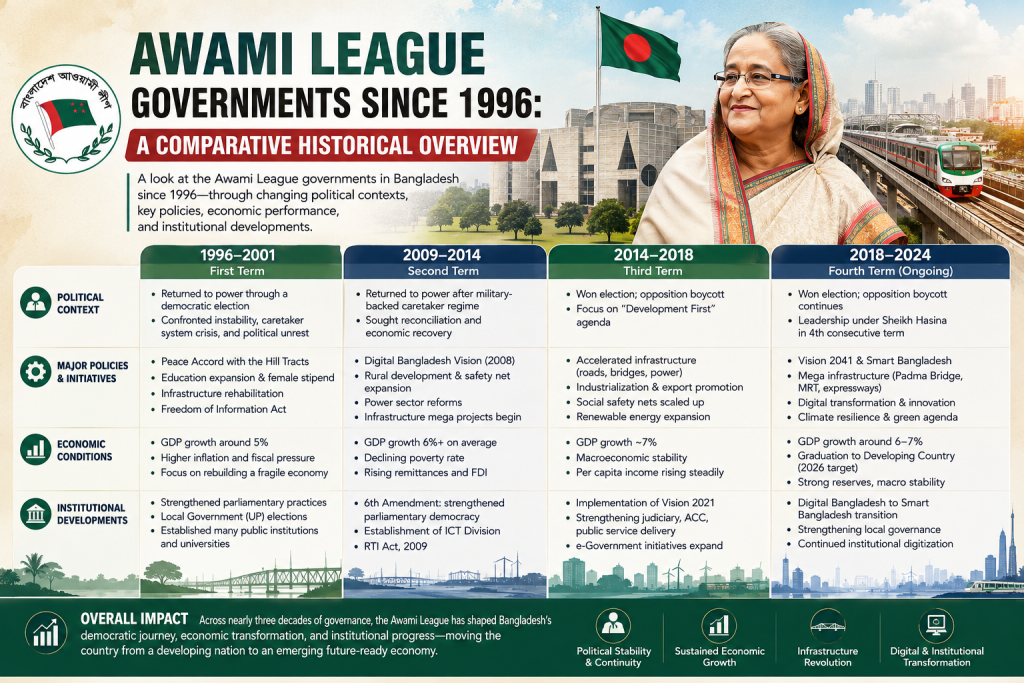
Economically, this second period coincided with major structural changes in Bangladesh: rapid GDP growth, expansion of electricity access, growth in exports and infrastructure investment, declining poverty and significant expansion of digital services. At the same time, later years brought concerns about inflation, foreign-exchange pressures, financial-sector weaknesses, inequality and the inclusiveness of economic growth.
The story, therefore, is not simply one of political continuity. It is a story of two substantially different phases of Awami League rule, separated by opposition rule and characterized by very different national and international circumstances.
1. Timeline of Awami League Governments Since 1996
| Period | Political situation | Broad characteristics |
|---|---|---|
| 1996–2001 | Awami League government under Sheikh Hasina | Democratic transition, institutional rebuilding, diplomacy, peace initiatives, social programs |
| 2001–2006 | BNP government | Awami League in opposition |
| 2007–2008 | Caretaker government | Political transition and election preparation |
| 2009–2013 | First government after 2008 election | Digital Bangladesh, power expansion, social programs, infrastructure |
| 2014–2018 | Second consecutive Awami League government | Political continuity, major infrastructure projects, constitutional/electoral controversy |
| 2019–2024 | Third consecutive term after 2018 election | Mega-projects, rapid growth, Padma Bridge, pandemic management, economic pressures |
| 2024 | Awami League won January election but government ended in August | Political crisis, mass protests and transition to interim government |
The United Nations reported on 5 August 2024 that Prime Minister Sheikh Hasina had resigned and that plans were being made for an interim government.
2. The Political Background to the 1996 Government
The first Awami League government of the period cannot be understood without examining the political crisis preceding the June 1996 election.
The February 1996 parliamentary election was boycotted by the principal opposition parties and produced a government that lasted only briefly. The subsequent 13th Amendment to the Constitution established the caretaker-government system, under which a non-party administration would oversee national elections.
The June 1996 election was therefore conducted under a caretaker administration headed by Justice Muhammad Habibur Rahman.
The Awami League won 146 of the 300 parliamentary seats, with Sheikh Hasina becoming prime minister.
This created an important historical contrast with the later Awami League period.
The 1996 political environment
The government faced:
- A strong parliamentary opposition
- Regular political confrontation
- Frequent parliamentary boycotts
- A newly institutionalized caretaker election mechanism
- Pressure to consolidate democratic institutions
- Long-standing disputes with neighboring India
- The unresolved conflict in the Chittagong Hill Tracts
- Poverty and weak infrastructure
The World Bank’s assessment of the period noted that Bangladesh had experienced political confrontation alongside improving economic and social indicators. GDP per capita growth during 1991–98 was significantly higher than during the preceding period.
3. Major Policies and Achievements of the 1996–2001 Government
3.1 Ganges Water-Sharing Treaty
One of the government’s most significant foreign-policy initiatives was the 30-year Ganges Water Sharing Treaty with India, signed on 12 December 1996.
The treaty addressed a longstanding dispute over the distribution of Ganges water and took effect in January 1997.
The agreement became one of the defining diplomatic achievements associated with the first Hasina government.
It also demonstrated the government’s emphasis on improving relations with India through negotiated bilateral agreements.
3.2 Chittagong Hill Tracts Peace Accord
Another major development was the Chittagong Hill Tracts Peace Accord, signed on 2 December 1997.
The agreement followed years of conflict between the government and the Parbatya Chattagram Jana Samhati Samiti (PCJSS).
The agreement created mechanisms for regional administration and sought to address longstanding political and security issues in the hill districts.
However, implementation has remained a subject of debate. Some issues concerning land, autonomy, demilitarization and the rights of indigenous communities have continued to generate political discussion.
Thus, historically, the agreement is both:
- A major peace initiative, and
- An unfinished institutional and political process.
3.3 Social Safety-Net Programs
The first Awami League government expanded several programs aimed at vulnerable groups.
These included support for:
- Widows
- Elderly people
- Persons with disabilities
- Freedom fighters
- Landless people
- Poor rural households
The government also promoted programs associated with housing and rural development.
The broader policy direction was to combine economic development with targeted social assistance.
4. Food Security and Agriculture
Agriculture was another important policy area during the 1996–2001 period.
The government emphasized:
- Agricultural inputs
- Farmer support
- Food production
- Rural development
- Irrigation
- Agricultural credit
The government subsequently described the period as one in which Bangladesh moved toward greater food self-sufficiency. Official historical accounts also identify agricultural and social-protection policies as major components of the government’s agenda.
The agricultural transformation was not solely the result of one government, however. It reflected longer-term changes involving farmers, private-sector input markets, irrigation, rural roads, technology and successive governments.
5. Community Health and Education
The 1996–2001 period also saw expansion of community-level health initiatives.
Community clinics became an important element of the government’s attempt to bring primary healthcare closer to rural populations.
Education policies also emphasized:
- Expansion of access
- Literacy
- Rural schooling
- Support for disadvantaged groups
These initiatives formed part of a broader shift toward human-development policies.
6. Institutional Developments During 1996–2001
Institutional reform was an important part of the first period.
Banglapedia records several parliamentary initiatives, including strengthening parliamentary committees and introducing a Prime Minister’s question-and-answer session.
The government also repealed the Indemnity Ordinance, opening the way for legal proceedings concerning the assassination of Sheikh Mujibur Rahman and other killings associated with the events of 1975.
This became an important part of the Awami League’s political and historical agenda.
At the same time, relations between the government and opposition remained highly confrontational, with opposition lawmakers frequently boycotting parliamentary sessions.
7. The 2001 Election and Transfer of Power
The Awami League completed its five-year term and transferred power to a caretaker government in July 2001.
The subsequent October 2001 election brought the BNP-led alliance to power.
This transition is historically important because it demonstrated the functioning of the caretaker-election arrangement.
The 1996 and 2001 elections both occurred under caretaker administrations, a system that would later become one of the central disputes in Bangladesh’s constitutional and political history.
8. The Return of the Awami League in 2009
The next major Awami League government began after the December 2008 parliamentary election.
The party campaigned on a broad development agenda associated with Vision 2021 and the concept of Digital Bangladesh.
The political environment was substantially different from 1996.
After political instability and the 2007–08 caretaker period, voters participated in an election that brought a large Awami League-led alliance majority to parliament.
The government’s priorities included:
- Economic growth
- Electricity generation
- Digitalization
- Infrastructure
- Social protection
- Education
- Health
- Food security
- Information technology
- Industrialization
This marked the beginning of the longest continuous period of Awami League national government in Bangladesh’s post-1990 parliamentary era.
9. Digital Bangladesh
One of the signature policy concepts of the post-2008 government was Digital Bangladesh.
The concept sought to expand:
- Internet connectivity
- Digital government services
- Information technology
- Online public services
- Digital education
- Mobile financial services
- Technology-based entrepreneurship
Government service delivery increasingly moved online during this period.
The transformation was supported by the rapid spread of mobile phones, internet connectivity and private-sector technology services.
This was one of the clearest differences between the 1996–2001 government and the post-2009 governments.
1996–2001
The central development challenges included:
- Basic infrastructure
- Food security
- Rural health
- Poverty
- Peace agreements
- Traditional public administration
2009–2024
The development agenda increasingly included:
- Digital government
- Broadband
- ICT
- Technology entrepreneurship
- Smart infrastructure
- Digital financial services
- Large-scale infrastructure
10. Electricity Expansion
Electricity became a major policy priority after 2009.
Bangladesh substantially expanded electricity generation and household access over the following decade.
World Bank data show that electricity access increased dramatically over the longer development period, reaching roughly universal access by the early 2020s.
The expansion supported:
- Manufacturing
- Rural businesses
- Education
- Household consumption
- Digital connectivity
- Urbanization
However, the later period also experienced fuel-price pressures, power shortages and energy-sector financial pressures.
Thus, the electricity story contains both an enormous expansion of access and continuing questions about the cost and sustainability of the energy system.
11. Infrastructure and Mega Projects
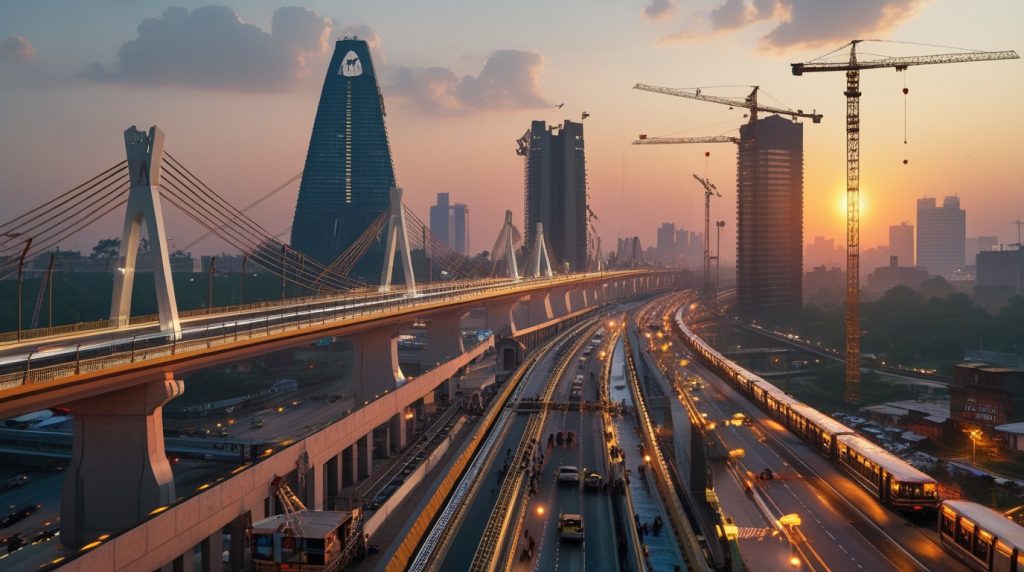
The post-2009 period witnessed an unprecedented expansion of large infrastructure projects.
Major projects included:
- Padma Bridge
- Dhaka Metro Rail
- Karnaphuli Tunnel
- Dhaka elevated expressway-related infrastructure
- Major highways
- Power plants
- Airports and port-related infrastructure
These projects reflected a development strategy based increasingly on large-scale public investment.
Padma Bridge
The Padma Bridge became particularly important economically and politically.
It was constructed with domestic financing after the World Bank withdrew from the project following allegations of corruption that the World Bank later said did not establish credible evidence sufficient to proceed with financing.
The completed bridge became a major symbol of Bangladesh’s infrastructure ambitions.
It also connected southwestern Bangladesh more directly to Dhaka and major economic centers.
12. Economic Transformation After 2009
The economic environment of the post-2009 period was very different from the 1990s.
Bangladesh experienced:
- Sustained GDP growth
- Rising per-capita income
- Expansion of exports
- Growth in ready-made garments
- Higher remittance flows
- Urbanization
- Growth in electricity access
- Expansion of infrastructure
- Declining poverty
The World Bank reports that Bangladesh’s GDP per capita increased more than twentyfold between independence and 2022, reaching about $2,742 in 2022.
The Bank’s more recent poverty assessment also found that between 2010 and 2022, Bangladesh lifted approximately 34 million people out of poverty or multidimensional poverty, although the pace of poverty reduction slowed after 2016.
These improvements cannot all be attributed to a single government; they represent long-term national trends involving successive governments, businesses, workers, farmers, migrants and international partners.
Nevertheless, the period of sustained Awami League government coincided with a particularly rapid phase of economic transformation.
13. Poverty Reduction
Poverty reduction is one of the most significant measurable developments associated with Bangladesh’s broader development trajectory.
The World Bank reports that moderate poverty fell from 37.1% in 2010 to 18.7% in 2022, while extreme poverty fell from 12.2% to 5.6% during the same period.
Important drivers included:
- Employment growth
- Garment exports
- Remittances
- Agricultural productivity
- Rural infrastructure
- Electricity expansion
- Social protection
- Female labor-force participation
However, the World Bank also notes that poverty reduction became less inclusive after 2016 and that inequality increased in some dimensions.
Therefore, evaluating the economic record requires looking beyond GDP growth alone.
14. Women’s Economic Participation
Bangladesh experienced substantial growth in women’s participation in economic activity during the broader post-2000 period.
The World Bank reports a 32% increase in female labor-market participation since 2000.
The ready-made garment sector was particularly important.
Women also became increasingly visible in:
- Education
- Healthcare
- Government employment
- Microfinance
- Manufacturing
- Small businesses
- Services
The government expanded various programs aimed at girls’ education and women’s empowerment.
Again, however, these developments reflected broader socioeconomic forces rather than government policy alone.
15. The 2011 Constitutional Amendment
One of the most consequential institutional changes during the second Awami League era was the 15th Amendment to the Constitution in 2011.
Among other changes, it removed the constitutional caretaker-government chapter.
The official constitutional text records that Chapter IIA concerning the non-party caretaker government was omitted by the Fifteenth Amendment.
This change had enormous consequences for Bangladesh’s electoral politics.
Supporters of the change argued that the caretaker system had constitutional and political problems.
Opponents argued that an election conducted under a government in power could not provide sufficient confidence to the opposition.
The issue eventually became one of the central causes of political confrontation surrounding the 2014, 2018 and 2024 elections.
The Bangladesh Supreme Court later addressed aspects of the Fifteenth Amendment and held that the repeal of the caretaker provisions had constitutional implications.
16. The 2014 Election
The 2014 parliamentary election represented a major turning point.
The BNP-led opposition alliance boycotted the election.
As a result, many constituencies had no effective electoral contest, and the Awami League secured another parliamentary term.
International observers and analysts subsequently raised significant concerns about electoral competitiveness and political participation.
International IDEA describes the period beginning in 2014 as a decline in electoral integrity compared with earlier elections.
This created a fundamental contrast with the 1996–2001 period, when the caretaker system was functioning as the accepted mechanism for election administration.
17. The 2018 Election
The 2018 election was conducted under the regular government rather than a caretaker administration.
The Awami League-led alliance won a large parliamentary majority.
However, the election generated allegations concerning:
- Intimidation
- Irregularities
- Unequal campaign conditions
- Violence
- Restrictions on opposition activity
International IDEA has described the 2018 election as suffering from significant electoral-integrity problems.
The government and its supporters disputed various opposition allegations.
For a historical assessment, it is therefore important to distinguish documented election outcomes from contested interpretations of how those outcomes were produced.
18. The 2018–2024 Period
The third consecutive Awami League government faced a dramatically different set of challenges.
The government pursued:
- Mega infrastructure
- Economic modernization
- Digitalization
- Export growth
- Energy expansion
- Transport projects
- Social protection
- Climate adaptation
But this period also included the COVID-19 pandemic and significant global economic disruptions.
Bangladesh faced:
- Inflation
- Foreign-exchange shortages
- Higher import costs
- Energy-price pressures
- Reserve pressures
- Financial-sector vulnerabilities
The World Bank reported that Bangladesh’s real GDP growth slowed to 6.0% in FY2023 from 7.1% in FY2022, while inflation and balance-of-payments pressures increased.
19. COVID-19 and the Economy
The COVID-19 pandemic represented an extraordinary challenge for the 2019–2024 government.
Lockdowns and restrictions disrupted:
- Garment production
- Transport
- Tourism
- Small businesses
- Education
- International trade
The government introduced stimulus and support measures for businesses and affected households.
The economy eventually recovered, but the pandemic also contributed to later financial and fiscal pressures.
20. The Rohingya Crisis
Beginning in 2017, Bangladesh faced the massive arrival of Rohingya refugees from Myanmar.
The government allowed hundreds of thousands of refugees to enter Bangladesh and established large refugee settlements in Cox’s Bazar.
The crisis became one of the country’s largest humanitarian and foreign-policy challenges.
The World Bank notes that international assistance subsequently supported Bangladesh in responding to the influx of displaced Rohingya people.
The crisis placed pressure on:
- Local infrastructure
- Environment
- Public services
- Security
- Humanitarian resources
- Diplomatic relations with Myanmar
21. Institutional Development: Comparing the Two Eras
Institutionally, the two Awami League periods were quite different.
1996–2001
The government focused on:
- Parliamentary committees
- Parliamentary procedures
- Local government participation
- Peace institutions in the Chittagong Hill Tracts
- Social-protection mechanisms
- Repealing the Indemnity Ordinance
2009–2024
Institutional developments included:
- Digital government
- Expanded administrative capacity
- Large infrastructure institutions
- New regulatory frameworks
- Expansion of social-protection systems
- Constitutional changes
- War-crimes trials
- Increased centralization of political power
The last point is particularly contested.
International IDEA’s recent review describes the 2009–2024 period as involving increasing concentration of political power and argues that state institutions were increasingly used in support of partisan interests. These are analytical judgments attributed to the report and should not be treated as uncontested facts.
22. War-Crimes Trials
Another defining institutional development of the post-2009 period was the prosecution of individuals accused of crimes committed during the 1971 Liberation War.
The government established the International Crimes Tribunal to prosecute alleged war crimes.
The trials were politically significant because they addressed unresolved issues from the independence period.
Supporters viewed the proceedings as an effort to establish accountability for 1971 atrocities.
Critics raised concerns regarding aspects of due process and the political context surrounding the trials.
The issue remains an important part of the historical assessment of the Awami League’s post-2009 government.
23. Foreign Policy: 1996 vs. 2009–2024
The foreign-policy priorities of the two eras reflected different circumstances.
1996–2001
Major priorities included:
- Relations with India
- Ganges water sharing
- Chittagong Hill Tracts peace
- Regional cooperation
- Resolving long-standing bilateral disputes
2009–2024
Foreign policy became broader and more economically oriented.
It included:
- India relations
- China relations
- United States and European Union relations
- Regional connectivity
- Bay of Bengal geopolitics
- Maritime boundaries
- Rohingya diplomacy
- Infrastructure financing
- Trade and investment
The government also settled maritime-boundary disputes with Myanmar and India during the second era.
24. Economy: 1996–2001 vs. 2009–2024
A simple comparison illustrates the scale of change.
| Indicator/area | 1996–2001 | 2009–2024 |
|---|---|---|
| Economic stage | Developing, lower-income economy | Rapidly industrializing economy |
| Main development challenge | Food security and basic services | Diversification and middle-income transition |
| Agriculture | Major economic focus | Increasingly mechanized/commercial |
| Electricity | Limited access | Near-universal access |
| Digital services | Minimal | Major government and private-sector ecosystem |
| Infrastructure | Roads, bridges, rural infrastructure | Mega-projects, metro rail, expressways, tunnels |
| Export economy | Garments growing | Garments dominant with broader diversification efforts |
| Poverty | High | Substantially reduced |
| Financial sector | Early liberalization/reform | Much larger but increasingly stressed financial system |
| Global integration | Growing | Deeply integrated into trade, migration and finance |
The World Bank’s historical data illustrate the broader transformation: electricity access, human development and per-capita income improved substantially over the decades.
25. What Changed Most Between the Two Periods?
The biggest difference is perhaps the scale and duration of government.
The first government lasted approximately five years.
The second era lasted approximately fifteen years, creating continuity in:
- Policy
- Administration
- Infrastructure planning
- Development strategy
- International relations
- Digitalization
- Social programs
Long-term continuity made it possible to undertake projects that require many years to complete.
However, long political continuity also intensified debates about:
- Political competition
- Institutional independence
- Electoral fairness
- Opposition participation
- Media freedom
- Checks and balances
These questions became increasingly prominent in the later years.
26. Economic Success and Economic Vulnerability
An objective historical assessment needs to recognize both sides of Bangladesh’s economic transformation.
Positive developments documented by international institutions
Bangladesh achieved:
- Major poverty reduction
- Strong economic growth for much of the 2010s
- Increased electricity access
- Higher life expectancy and improved social indicators
- Increased female labor-force participation
- Major infrastructure development
- Expansion of exports
- Rising per-capita income
The World Bank describes Bangladesh as one of the world’s faster-growing economies over much of the preceding decade.
Emerging vulnerabilities
By the early 2020s, the country faced:
- Inflation
- Foreign-exchange pressures
- Banking-sector weaknesses
- Rising financial vulnerabilities
- Slower poverty reduction
- Inequality concerns
- Energy-price pressures
The World Bank has specifically identified financial-sector vulnerabilities and regulatory weaknesses as important structural concerns.
Thus, the economic record should not be reduced either to GDP growth alone or to economic difficulties alone.
27. The Final Phase: 2024
The January 2024 parliamentary election returned the Awami League to government for another term.
However, the election took place amid a major opposition boycott and concerns about electoral competitiveness.
International IDEA reports that the Awami League won 222 of the 300 contested seats, while turnout was below 40 percent according to Bangladesh’s Election Commission.
The government lasted only several months.
Large-scale protests escalated during the summer of 2024.
On 5 August 2024, Sheikh Hasina resigned and left office. The United Nations confirmed the announcement of her resignation and plans for an interim government.
This brought the longest uninterrupted Awami League period in national government to an end.
28. A Comparative Summary
The historical trajectory can be summarized in four broad stages.
Stage 1: 1996–2001 — Re-entry and Institution Building
The central themes were:
- Democratic restoration
- Parliamentary politics
- Foreign-policy agreements
- Peace negotiations
- Food security
- Social protection
- Rural development
Stage 2: 2009–2013 — Development and Digitalization
The focus shifted toward:
- Electricity
- Digital Bangladesh
- Education
- Infrastructure
- Social programs
- Economic growth
Stage 3: 2014–2018 — Continuity and Political Contestation
The government continued development policies while political debate increasingly centered on:
- Electoral competition
- Caretaker government
- Opposition participation
- Institutional independence
Stage 4: 2019–2024 — Mega Projects, Economic Pressure and Political Crisis
The period combined:
- Major infrastructure
- Economic transformation
- COVID-19
- Rohingya crisis
- Inflation
- Financial-sector pressures
- Electoral controversy
- Political unrest
29. Major Similarities Between the Awami League Governments
Despite their differences, several themes appeared in both periods.
1. Development-oriented politics
Both governments emphasized economic and social development.
2. Rural development
Agriculture, rural infrastructure and social protection remained important.
3. Social programs
Both periods included programs targeting disadvantaged groups.
4. India relations
Relations with India were an important component of foreign policy in both periods.
5. Historical identity
The Liberation War and the legacy of Sheikh Mujibur Rahman remained central to the party’s political narrative.
30. Major Differences
The differences were equally significant.
Political environment
1996–2001: competitive parliamentary politics with a functioning caretaker system.
2009–2024: long-term one-party dominance in government, with increasing controversy over electoral competition.
Economic environment
1996–2001: Bangladesh was still primarily focused on overcoming basic development constraints.
2009–2024: Bangladesh became a significantly larger, more industrialized and globally integrated economy.
Technology
1996–2001: traditional administration.
2009–2024: digital government and widespread internet/mobile technology.
Infrastructure
1996–2001: foundational infrastructure.
2009–2024: mega-projects and urban transportation systems.
Institutional debate
1996–2001: parliamentary strengthening and democratic consolidation.
2009–2024: institutional expansion accompanied by increasingly intense debate over separation of powers, elections and political accountability.
31. Overall Historical Significance
The Awami League governments Bangladesh experienced since 1996 represent two very different chapters of the country’s modern political history.
The first, from 1996 to 2001, was relatively short and concentrated on political normalization, diplomatic agreements, peace-building, food security and social programs.
The second, beginning in 2009, transformed the scale of government policy. Over approximately fifteen years, Bangladesh experienced rapid economic growth, infrastructure expansion, digitalization and major poverty reduction.
At the same time, the later period saw increasing political controversy, especially surrounding elections, opposition participation and institutional checks and balances.
This combination makes the period historically complex.
A balanced historical assessment therefore needs to consider both measurable socioeconomic changes and institutional-political developments rather than judging the period exclusively through either economic indicators or political events.
32. Frequently Asked Questions
What years did the Awami League govern Bangladesh since 1996?
The Awami League governed from 1996 to 2001 and then continuously from 2009 until August 2024, under Sheikh Hasina.
Who led the Awami League governments during these periods?
Sheikh Hasina served as prime minister throughout both major periods: 1996–2001 and 2009–2024.
What was the major achievement of the 1996–2001 government?
Major developments included the Ganges Water Sharing Treaty, the Chittagong Hill Tracts Peace Accord, social-protection programs, rural development initiatives and food-security policies.
What was Digital Bangladesh?
Digital Bangladesh was a development vision emphasizing information technology, digital public services, internet connectivity and technology-based economic development.
When was the caretaker government system abolished?
The constitutional caretaker-government provisions were removed through the Fifteenth Amendment in 2011.
Why were the later elections controversial?
The 2014, 2018 and 2024 elections faced substantial criticism over electoral competitiveness, opposition participation and irregularities. International IDEA has documented a deterioration in electoral-integrity conditions after 2014.
Did Bangladesh’s economy improve during the Awami League’s long period in office?
Bangladesh experienced substantial economic and social improvements during this period, including poverty reduction, higher per-capita income, electricity expansion and infrastructure development. However, economic performance also became more vulnerable to inflation, foreign-exchange pressures and financial-sector weaknesses in the early 2020s.
When did the Awami League’s most recent government end?
The government ended in August 2024, following Sheikh Hasina’s resignation amid mass protests.
Conclusion
The history of Awami League governments Bangladesh since 1996 is best understood as a progression from democratic re-entry and foundational policy initiatives to long-term development-oriented government and, eventually, intense political and institutional controversy.
The 1996–2001 government is particularly associated with the Ganges treaty, the Chittagong Hill Tracts Peace Accord, food security, rural development and social programs.
The 2009–2024 era was far broader in scale. It coincided with Bangladesh’s transformation into a substantially larger economy, major poverty reduction, near-universal electricity access, digitalization and unprecedented infrastructure development.
At the same time, the later period cannot be separated from debates over constitutional changes, electoral competition, institutional independence and political participation. Those issues became especially important after the abolition of the caretaker-government system and the elections held in 2014, 2018 and 2024.
Taken together, these developments make the Awami League’s post-1996 governments one of the most consequential subjects for understanding Bangladesh’s modern political economy.
Sources for further reading
- World Bank — Bangladesh development, poverty and economic data.
- International IDEA — Bangladesh’s electoral and constitutional developments.
- Supreme Court of Bangladesh — constitutional developments concerning the Fifteenth Amendment.
- Banglapedia — historical background of the Awami League and its governments.
- United Nations — statement concerning the August 2024 political transition.