The Sands of Dee: Answering questions from poem for SSC Examination 2027-2028
The Sands of Dee
-Charles Kingsley
“O Mary, go and call the cattle home,
And call the cattle home,
And call the cattle home
Across the sands of Dee”;
The western wind was wild and dank with foam,
And all alone went she.
The western tide crept up along the sand,
And o’er and o’er the sand,
And round and round the sand,
As far as eye could see.
The rolling mist came down and hid the land:
And never home came she.
“Oh! is it weed, or fish, or floating hair—
A tress of golden hair,
A drownèd maiden’s hair
Above the nets at sea?
Was never salmon yet that shone so fair
Among the stakes on Dee.”
They rowed her in across the rolling foam,
The cruel crawling foam,
The cruel hungry foam,
To her grave beside the sea:
But still the boatmen hear her call the cattle home
Across the sands of Dee.
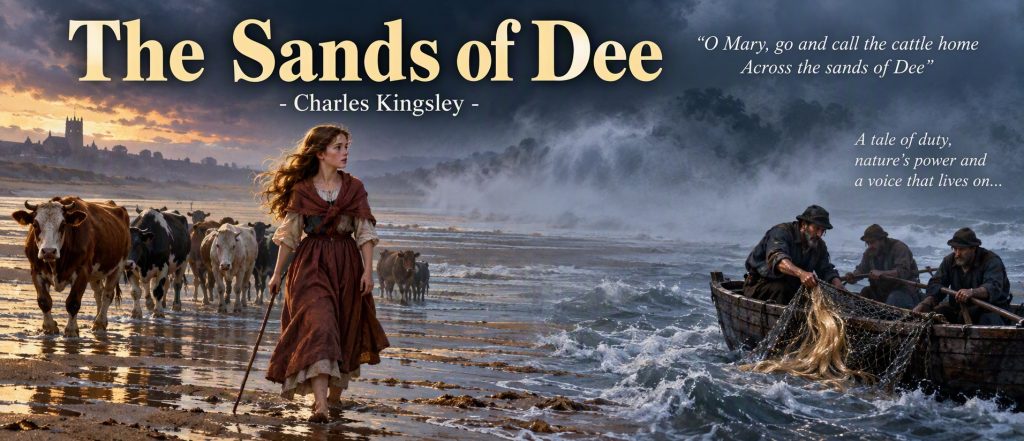
The Sands of Dee
চার্লস কিংসলি (Charles Kingsley)
“O Mary, go and call the cattle home,
ও মেরি, যাও, গবাদি পশুগুলোকে ঘরে ফিরিয়ে আনো,
And call the cattle home,
আর গবাদি পশুগুলোকে ঘরে ফিরিয়ে আনো,
And call the cattle home
আর গবাদি পশুগুলোকে ঘরে ফিরিয়ে আনো
Across the sands of Dee”;
ডি নদীর বালুচর পেরিয়ে।
The western wind was wild and dank with foam,
পশ্চিমা বাতাস ছিল প্রচণ্ড ও সাগরের ফেনায় সিক্ত,
And all alone went she.
আর সে একাই রওনা হলো।
The western tide crept up along the sand,
পশ্চিম দিকের জোয়ার ধীরে ধীরে বালুচরের ওপর এগিয়ে এলো,
And o’er and o’er the sand,
আর বারবার সেই বালুচর ঢেকে দিল,
And round and round the sand,
আর চারদিক থেকে বালুচর ঘিরে ফেলল,
As far as eye could see.
যতদূর চোখে দেখা যায়।
The rolling mist came down and hid the land:
ঘন ঘূর্ণায়মান কুয়াশা নেমে এসে ভূমিকে আড়াল করে দিল,
And never home came she.
আর সে আর কখনো ঘরে ফিরে এল না।
“Oh! is it weed, or fish, or floating hair—
“ওহ! ওটা কি সামুদ্রিক আগাছা, মাছ, নাকি ভাসমান চুল—
A tress of golden hair,
একগুচ্ছ সোনালি চুল,
A drownèd maiden’s hair
ডুবে-মরা এক কিশোরীর চুল
Above the nets at sea?
সমুদ্রের জালের ওপরে ভেসে আছে?
Was never salmon yet that shone so fair
কোনো স্যামন মাছ কখনো এত সুন্দরভাবে ঝলমল করেনি
Among the stakes on Dee.”
ডি নদীর খুঁটিগুলোর মাঝে।”
They rowed her in across the rolling foam,
তারা তাকে নৌকায় করে উথাল-পাথাল ফেনার মধ্য দিয়ে তীরে নিয়ে এলো,
The cruel crawling foam,
সেই নিষ্ঠুর ধীরে এগিয়ে আসা ফেনা,
The cruel hungry foam,
সেই নিষ্ঠুর, গ্রাসকারী ফেনা,
To her grave beside the sea:
সমুদ্রের তীরের পাশে তার কবরে নিয়ে গেল,
But still the boatmen hear her call the cattle home
তবুও আজও মাঝিরা যেন তার গরুগুলোকে ঘরে ফেরানোর ডাক শুনতে পায়,
Across the sands of Dee.
ডি নদীর বালুচর পেরিয়ে।
Summary (English)
The Sands of Dee is a tragic narrative poem about a girl named Mary who is sent across the sands of the River Dee to bring the cattle home. Despite the dangerous weather, she goes alone. As the tide rises and a thick mist covers the land, Mary becomes lost and is drowned. Later, people notice what appears to be a strand of her golden hair floating above the sea. Her body is eventually recovered and buried beside the sea. However, according to legend, the boatmen still hear her voice calling the cattle home across the sands of Dee. The poem highlights the power of nature and the sadness of an untimely death.
বাংলা সারাংশ
“The Sands of Dee” একটি করুণ কাহিনিভিত্তিক কবিতা। মেরি নামের এক তরুণীকে ডি নদীর বালুচর পেরিয়ে গরুগুলোকে বাড়ি ফিরিয়ে আনতে বলা হয়। সে একাই রওনা দেয়। কিন্তু জোয়ার বাড়তে থাকে এবং ঘন কুয়াশায় চারদিক ঢেকে যায়। ফলে মেরি পথ হারিয়ে সাগরের জলে ডুবে মারা যায়। পরে জেলেরা সাগরে তার সোনালি চুলের আভাস দেখতে পায় এবং তার মৃতদেহ উদ্ধার করে সমুদ্রতীরে সমাহিত করে। তবুও লোককথা অনুযায়ী মাঝিরা এখনো তার কণ্ঠস্বর শুনতে পায়, যেন সে গরুগুলোকে বাড়ি ডাকছে। কবিতাটি প্রকৃতির শক্তি এবং মানবজীবনের অসহায়ত্বকে তুলে ধরে।
Theme of the Poem (English)
The central theme of the poem is the destructive power of nature and the tragedy of human helplessness before it. The poem also explores themes of death, loss, sorrow, and remembrance. Mary’s death shows how quickly nature can turn dangerous, while her lingering voice symbolizes how memories survive even after death.
কবিতার থিম (বাংলা)
কবিতার মূল বিষয় হলো প্রকৃতির অপ্রতিরোধ্য শক্তি এবং তার সামনে মানুষের অসহায়ত্ব। এছাড়াও এতে মৃত্যু, বেদনা, ক্ষতি ও স্মৃতির অমরত্ব তুলে ধরা হয়েছে। মেরির মৃত্যু প্রকৃতির ভয়ংকর দিককে প্রকাশ করে, আর তার কণ্ঠস্বরের প্রতিধ্বনি স্মৃতির চিরস্থায়িত্বের প্রতীক।
The Sands of Dee – Stanza-wise Explanation
Stanza 1
“O Mary, go and call the cattle home…”
In this stanza, Mary is asked to bring the cattle home across the sands of the River Dee. The weather is already rough, with a wild western wind and sea foam everywhere. Despite the danger, Mary sets out alone. This stanza introduces the main character and creates a sense of loneliness and foreboding.
বাংলা ব্যাখ্যা
এই স্তবকে মেরিকে ডি নদীর বালুচর পেরিয়ে গবাদি পশুগুলোকে বাড়ি ফিরিয়ে আনতে বলা হয়। আবহাওয়া ছিল প্রতিকূল; পশ্চিমা বাতাস ছিল প্রবল এবং ফেনায় ভরা। তবুও মেরি একাই রওনা দেয়। এই স্তবকটি ভবিষ্যৎ বিপদের ইঙ্গিত দেয়।
Stanza 2
“The western tide crept up along the sand…”
As Mary crosses the sands, the tide gradually rises and spreads over the area. At the same time, a thick mist descends and hides the land from view. Surrounded by water and fog, Mary becomes lost and never returns home. This stanza describes the tragic event of her disappearance.
বাংলা ব্যাখ্যা
এই স্তবকে জোয়ার ধীরে ধীরে বালুচরকে প্লাবিত করতে থাকে এবং ঘন কুয়াশা চারদিক ঢেকে ফেলে। ফলে মেরি পথ হারিয়ে ফেলে এবং আর কখনো বাড়ি ফিরে আসতে পারে না। এখানে তার করুণ মৃত্যুর ইঙ্গিত দেওয়া হয়েছে।
Stanza 3
“Oh! is it weed, or fish, or floating hair…”
People notice something floating in the sea. At first, they wonder whether it is seaweed, a fish, or hair. Then they realize it is the beautiful golden hair of the drowned Mary. Her shining hair stands out among the fishing nets and stakes in the River Dee. This stanza reveals Mary’s fate.
বাংলা ব্যাখ্যা
এই স্তবকে লোকেরা সমুদ্রে ভাসতে থাকা একটি বস্তু দেখতে পায়। প্রথমে তারা বুঝতে পারে না সেটি আগাছা, মাছ নাকি চুল। পরে তারা বুঝতে পারে সেটি ডুবে মারা যাওয়া মেরির সোনালি চুল। এভাবেই মেরির মৃত্যুর বিষয়টি প্রকাশ পায়।
Stanza 4
“They rowed her in across the rolling foam…”
Mary’s body is brought ashore through the waves and buried beside the sea. The sea is described as cruel and hungry because it has taken her life. Even after her death, the boatmen believe they can still hear her voice calling the cattle home across the sands of Dee. This creates a haunting and emotional ending.
বাংলা ব্যাখ্যা
এই স্তবকে মেরির মৃতদেহ তীরে আনা হয় এবং সমুদ্রের পাশে তাকে কবর দেওয়া হয়। কবি সমুদ্রকে নিষ্ঠুর ও গ্রাসকারী হিসেবে বর্ণনা করেছেন, কারণ এটি মেরির জীবন কেড়ে নিয়েছে। কিন্তু লোককথা অনুযায়ী মাঝিরা এখনো তার কণ্ঠস্বর শুনতে পায়, যেন সে গবাদি পশুগুলোকে বাড়ি ডাকছে। এটি কবিতার বেদনাময় ও রহস্যময় সমাপ্তি।
Key Poetic Devices in The Sands of Dee
1. Repetition
The poet frequently repeats words and phrases to create rhythm, emphasize important ideas, and increase the emotional effect.
Examples:
- “And call the cattle home,”
- “And call the cattle home,”
- “And call the cattle home”
- “The cruel crawling foam,”
- “The cruel hungry foam,”
Effect: The repetition creates a musical quality and highlights Mary’s task and the tragic atmosphere.
2. Alliteration
Alliteration is the repetition of the same consonant sound at the beginning of nearby words.
Examples:
- “wild and dank with foam” (w sound)
- “cruel crawling foam” (c sound)
- “golden hair” (h sound)
Effect: It enhances the melody of the poem and makes certain images more vivid.
3. Personification
Personification gives human qualities to non-human objects or natural forces.
Examples:
- “The western tide crept up along the sand”
- “The cruel hungry foam”
Effect: The tide and foam seem alive and threatening, emphasizing nature’s destructive power.
4. Imagery
Imagery creates vivid pictures in the reader’s mind.
Examples:
- “rolling mist came down and hid the land”
- “A tress of golden hair”
- “rolling foam”
Effect: These descriptions help readers visualize the gloomy sea, the mist, and Mary’s tragic fate.
5. Symbolism
A symbol represents a deeper meaning beyond its literal sense.
Examples:
- The sea/tide symbolizes death and danger.
- The mist symbolizes confusion and uncertainty.
- Mary’s voice symbolizes memory that survives after death.
Effect: These symbols add depth to the poem’s meaning.
6. Metaphor
A metaphor makes an implied comparison without using “like” or “as.”
Example:
- “The cruel hungry foam”
The foam is compared to a hungry creature that devours Mary.
Effect: It makes the sea appear more frightening and powerful.
7. Assonance
Assonance is the repetition of vowel sounds within nearby words.
Example:
- “home,” “foam”
- “Dee,” “see,” “she,” “sea”
Effect: It creates a smooth, musical sound pattern.
8. Rhyme Scheme
The poem follows a regular rhyme pattern.
Example (First Stanza):
- home (A)
- home (A)
- home (A)
- Dee (B)
- foam (A)
- she (B)
Rhyme Scheme: AAABAB
Effect: The steady rhyme gives the poem a song-like quality.
9. Foreshadowing
Foreshadowing hints at future events.
Example:
- “The western wind was wild and dank with foam”
Effect: The stormy weather suggests that something bad is going to happen to Mary.
10. Ballad Features
The Sands of Dee is a ballad, a narrative poem that tells a story.
Ballad Characteristics:
- Tells a tragic story.
- Simple language.
- Repetition.
- Musical rhythm.
- Focus on a single dramatic event.
Effect: These features make the poem easy to remember and emotionally powerful.
Answers to the Questions from EFT
1. What was the weather like when Mary went to bring the cattle home?
Answer: The weather was rough and dangerous. The western wind was wild and damp with foam, and later a thick mist covered the land.
2. Look at some words, phrases and sentences that have been repeated several times. Explain why the poet has done that.
Answer: The poet uses repetition to create a musical rhythm and emphasize important ideas. It also makes the poem more emotional and memorable.
3. How has the poet described the sea?
Answer: The poet describes the sea as powerful, cruel, and hungry. It is shown as a destructive force that takes Mary’s life.
4. Narrate the story of Mary in your own words.
Answer: Mary was asked to bring the cattle home across the sands of Dee. She went alone despite the bad weather. As the tide rose and thick mist covered the land, she lost her way and drowned. Later, her body was found and buried beside the sea. According to legend, boatmen can still hear her voice calling the cattle home.
5. Suppose you were walking on the shore with a couple of your friends while Mary was drowning. Describe what you would have done.
Answer: If I had seen Mary drowning, I would have immediately called for help and informed nearby boatmen. My friends and I would have tried to rescue her using a rope, a boat, or any available safety equipment. We would have acted as quickly as possible to save her life.
Questions for More Practice
(a) What task was Mary given in the poem The Sands of Dee?
Answer: Mary was asked to go across the sands of Dee and bring the cattle home.
(b) What does the phrase “all alone went she” suggest about Mary in the poem The Sands of Dee?
Answer: It suggests that Mary went by herself without any companion and was vulnerable to danger.
(c) What is the significance of the “rolling mist” in the poem The Sands of Dee?
Answer: The rolling mist hid the land from view and caused Mary to lose her way. It also symbolizes confusion and danger.
(d) What tragic discovery is described in the poem The Sands of Dee?
Answer: The tragic discovery is Mary’s golden hair floating above the nets, revealing that she had drowned.
(e) What lingering effect does Mary’s voice have after her death in the poem The Sands of Dee?
Answer: The boatmen still believe they can hear her voice calling the cattle home across the sands of Dee.
(f) What theme does the poem The Sands of Dee explore through Mary’s fate?
Answer: The poem explores the themes of nature’s power, human helplessness, death, loss, and remembrance.
(g) How does the poet use imagery to describe Mary’s hair in the poem The Sands of Dee?
Answer: The poet describes her hair as a shining “tress of golden hair” floating above the sea, creating a vivid and memorable image.
(h) Why is the sea described as “hungry” in the poem The Sands of Dee?
Answer: The sea is called “hungry” because it swallowed Mary’s life and caused her death.
(i) How does the poem portray the relationship between humans and nature in The Sands of Dee?
Answer: The poem shows that human beings are weak compared to the mighty and often dangerous forces of nature.
(j) What is the significance of the final line, “Across the sands of Dee” in the poem The Sands of Dee?
Answer: The final line reminds readers of Mary’s tragic journey and keeps her memory alive through the boatmen’s legend.
(k) How does the poet create a sense of tragedy in The Sands of Dee?
Answer: The poet creates tragedy through the stormy weather, rising tide, thick mist, and Mary’s untimely death.
(l) What does “The cruel hungry foam” signify in the poem The Sands of Dee?
Answer: It signifies the destructive and merciless power of the sea that took Mary’s life.
(m) Do you like the poem The Sands of Dee? If then, why?
Answer: Yes, I like the poem because it tells a touching story and uses beautiful imagery and language to convey deep emotions.
(n) Who was Mary and what happened to her according to the poem The Sands of Dee?
Answer: Mary was a young girl who was sent to bring the cattle home. She got lost in the mist and drowned in the sea.
(o) What did the boatmen see in their nets at sea?
Answer: The boatmen saw what appeared to be Mary’s golden hair floating above the nets.
(p) What happened to Mary’s dead body in The Sands of Dee?
Answer: Mary’s body was brought ashore by boat and buried beside the sea.
(q) Who finds Mary in The Sands of Dee?
Answer: The boatmen found Mary’s drowned body and brought her back to shore.
(r) What is the significance of the boatmen in The Sands of Dee?
Answer: The boatmen help recover Mary’s body and keep her memory alive. They symbolize the people who continue to remember her tragic fate.
(s) How does the poem The Sands of Dee convey the idea of loss and remembrance?
Answer: The poem conveys loss through Mary’s death and remembrance through the belief that her voice can still be heard calling the cattle home. This suggests that memories of loved ones live on even after death.
(t) What comparison is made with Mary’s hair in The Sands of Dee?
Answer: Mary’s golden hair is compared to a shining salmon fish. The poet says that no salmon ever shone as beautifully as her hair.
(u) Who is the main character of the poem The Sands of Dee? How does the poet portray the character?
Answer: Mary is the main character of the poem. The poet portrays her as a dutiful, obedient, and innocent girl who becomes a victim of nature’s power.
(v) What does the “cruel crawling foam” signify in The Sands of Dee?
Answer: The phrase “cruel crawling foam” signifies the destructive and threatening power of the sea. It emphasizes the danger that led to Mary’s death.
(w) What feelings does the poem The Sands of Dee create in the mind of the readers?
Answer: The poem creates feelings of sadness, sympathy, sorrow, and pity for Mary. It also makes readers aware of the power of nature.
(x) What do the boatmen hear after Mary’s death?
Answer: After Mary’s death, the boatmen still hear her voice calling the cattle home across the sands of Dee.
(y) How is Mary’s hair described in the poem?
Answer: Mary’s hair is described as a beautiful “tress of golden hair” floating above the nets at sea. It shines brightly and attracts attention.
(z) How did Mary die and where was she buried?
Answer: Mary died by drowning after becoming lost in the rising tide and thick mist. She was buried beside the sea.
(z₁) What do the boatmen hear even today amidst the sands of Dee?
Answer: The boatmen hear Mary’s voice calling the cattle home across the sands of Dee even today.
(z₂) Why does The Sands of Dee focus on Mary’s youth?
Answer: The poem focuses on Mary’s youth to make her death more tragic and to highlight the loss of a young and innocent life.
(z₃) How was Mary’s dead body discovered?
Answer: Mary’s body was discovered when people noticed her golden hair floating above the nets at sea. The boatmen then recovered her body.
(z₄) What lesson or message can readers learn from Mary’s tragic story in The Sands of Dee?
Answer: Readers learn that nature is powerful and sometimes dangerous. The poem also teaches us to be careful and respect the forces of nature.
(z₅) What is the significance of the last line, “Across the Sands of Dee”?
Answer: The last line reinforces Mary’s tragic story and suggests that her memory continues to live on. It creates a haunting and emotional ending.
(z₆) Why does the poet focus on nature’s power in The Sands of Dee?
Answer: The poet focuses on nature’s power to show how helpless humans can be against natural forces such as the sea, tide, and mist.
(z₇) Why did Mary go across the sands of Dee?
Answer: Mary went across the sands of Dee because she was asked to bring the cattle home. It was her duty to do so.
Extra Important Questions and Answers
(r) Why did Mary not return home?
Answer: Mary did not return home because she was trapped by the rising tide and thick mist and eventually drowned.
(s) What does the sea symbolize in the poem?
Answer: The sea symbolizes danger, death, and the overwhelming power of nature.
(t) What does the mist symbolize in the poem?
Answer: The mist symbolizes confusion, uncertainty, and hidden danger.
(u) What type of poem is The Sands of Dee?
Answer: It is a narrative ballad because it tells a tragic story in a musical style.
(v) What is the central message of the poem?
Answer: The poem teaches that nature can be powerful and destructive, and human beings are often helpless before it.
(w) What qualities of Mary are shown in the poem?
Answer: Mary is shown as obedient, dutiful, and hardworking.
(x) Why do readers feel sympathy for Mary?
Answer: Readers feel sympathy because she dies while carrying out a simple duty and has no chance to save herself.
(y) What poetic device is used in “call the cattle home”?
Answer: Repetition is used in this phrase.
(z) What is the mood of the poem?
Answer: The mood of the poem is sad, gloomy, and tragic.
More Questions and Answers
1. Who wrote the poem The Sands of Dee?
Answer: Charles Kingsley wrote the poem The Sands of Dee.
2. Who is the main character of the poem?
Answer: Mary is the main character of the poem.
3. What was Mary asked to do?
Answer: Mary was asked to call the cattle home across the sands of Dee.
4. Where was Mary supposed to go?
Answer: She was supposed to go across the sands of the River Dee.
5. How was the western wind described?
Answer: The western wind was wild and damp with foam.
6. Did Mary go alone?
Answer: Yes, Mary went alone to bring the cattle home.
7. What was the weather like when Mary left?
Answer: The weather was rough and dangerous with strong wind.
8. What crept up along the sand?
Answer: The western tide crept up along the sand.
9. What covered the land?
Answer: A rolling mist covered the land.
10. Why could Mary not find her way home?
Answer: The mist and rising tide made her lose her way.
11. Did Mary return home safely?
Answer: No, Mary never returned home.
12. What does the phrase “never home came she” mean?
Answer: It means that Mary died and never came back home.
13. What came down and hid the land?
Answer: The rolling mist came down and hid the land.
14. How far did the tide spread?
Answer: It spread as far as the eye could see.
15. What did people see floating in the sea?
Answer: They saw something that looked like floating golden hair.
16. What did the people first think the object might be?
Answer: They thought it might be weed, fish, or hair.
17. Whose hair was floating above the nets?
Answer: It was the hair of drowned Mary.
18. What color was Mary’s hair?
Answer: Mary’s hair was golden.
19. What does “drownèd maiden” refer to?
Answer: It refers to Mary, who drowned in the sea.
20. Where was the hair seen?
Answer: The hair was seen above the nets at sea.
21. What fish is mentioned in the poem?
Answer: Salmon is mentioned in the poem.
22. Why is the salmon mentioned?
Answer: It is mentioned to compare its shine with Mary’s golden hair.
23. How was Mary’s body brought back?
Answer: Her body was brought back by boat.
24. Through what did the boatmen row?
Answer: They rowed through the rolling foam.
25. How is the foam described?
Answer: The foam is described as cruel and hungry.
26. Why is the foam called cruel?
Answer: It is called cruel because it took Mary’s life.
27. Where was Mary buried?
Answer: She was buried beside the sea.
28. What happened after Mary’s death?
Answer: Her body was buried, but her memory remained alive.
29. What do the boatmen still hear?
Answer: They still hear Mary calling the cattle home.
30. Why do the boatmen remember Mary?
Answer: They remember her because of her tragic death.
31. What is the setting of the poem?
Answer: The poem is set near the River Dee and the sea.
32. What type of poem is The Sands of Dee?
Answer: It is a narrative ballad.
33. What is the main theme of the poem?
Answer: The main theme is the power of nature and human helplessness.
34. What lesson does the poem teach?
Answer: It teaches that nature can be powerful and dangerous.
35. What mood is created in the poem?
Answer: The poem creates a sad and tragic mood.
36. Which natural forces cause Mary’s death?
Answer: The tide and mist cause Mary’s death.
37. What does the mist symbolize?
Answer: The mist symbolizes confusion and danger.
38. What does the sea symbolize?
Answer: The sea symbolizes death and destruction.
39. What does Mary’s voice symbolize?
Answer: Mary’s voice symbolizes memory and longing.
40. Why is Mary considered helpless?
Answer: She could not overcome the powerful forces of nature.
41. What poetic device is used in “call the cattle home”?
Answer: Repetition is used in the phrase.
42. What effect does repetition create?
Answer: It creates rhythm and emphasis.
43. Give an example of personification from the poem.
Answer: “The western tide crept up along the sand” is an example of personification.
44. What is alliteration?
Answer: Alliteration is the repetition of the same consonant sound in nearby words.
45. Give an example of alliteration from the poem.
Answer: “Cruel crawling foam” is an example of alliteration.
46. What is imagery?
Answer: Imagery is language that creates pictures in the reader’s mind.
47. Give an example of imagery from the poem.
Answer: “The rolling mist came down and hid the land” is vivid imagery.
48. Why is The Sands of Dee called a ballad?
Answer: It is called a ballad because it tells a tragic story in a musical style.
49. What feeling do readers have for Mary?
Answer: Readers feel sympathy and sadness for Mary.
50. How does the poem end?
Answer: The poem ends with the boatmen still hearing Mary’s call across the sands of Dee.
51. What was Mary’s duty in the poem?
Answer: Mary’s duty was to bring the cattle home across the sands of Dee.
52. Why is Mary an important character in the poem?
Answer: She is the central character whose tragic death forms the main story of the poem.
53. What natural setting is described in the poem?
Answer: The poem describes the sands, sea, tide, wind, and mist near the River Dee.
54. What danger was hidden in the sands of Dee?
Answer: The rising tide and thick mist made the sands dangerous.
55. What does the phrase “all alone went she” suggest?
Answer: It suggests that Mary had no one with her and was vulnerable.
56. How did the tide move?
Answer: The tide slowly crept up along the sand.
57. What effect did the mist have?
Answer: It hid the land and made it difficult to find the way.
58. Why is the mist important in the poem?
Answer: It contributed to Mary’s getting lost and drowning.
59. What happened to Mary because of the tide and mist?
Answer: She lost her way and drowned.
60. How does the poet describe the sea?
Answer: The poet describes the sea as cruel and hungry.
61. Why is the sea called hungry?
Answer: It is called hungry because it took Mary’s life.
62. What emotion does the poem mainly express?
Answer: The poem mainly expresses sadness and sorrow.
63. How did people react to the floating object?
Answer: They were curious and tried to identify it.
64. What did they finally realize?
Answer: They realized that it was Mary’s golden hair.
65. What does Mary’s golden hair symbolize?
Answer: It symbolizes her beauty and tragic death.
66. Why did the floating hair attract attention?
Answer: It shone brightly and looked unusual.
67. What is compared with Mary’s hair?
Answer: A salmon fish is compared with Mary’s hair.
68. What is the significance of the comparison with salmon?
Answer: It highlights the brightness and beauty of her hair.
69. Who brought Mary’s body back?
Answer: The boatmen brought her body back.
70. How was Mary’s body transported?
Answer: It was carried by boat across the sea foam.
71. Where was Mary laid to rest?
Answer: She was buried beside the sea.
72. Why is Mary’s death tragic?
Answer: She died young while performing a simple duty.
73. What memory of Mary remains after her death?
Answer: Her voice calling the cattle home remains in people’s memories.
74. Who still hears Mary’s voice?
Answer: The boatmen still hear Mary’s voice.
75. Is Mary’s voice real or legendary?
Answer: It is part of a local legend remembered by the boatmen.
76. What makes the ending haunting?
Answer: The belief that Mary’s voice is still heard after her death makes the ending haunting.
77. What does the poem say about nature?
Answer: It shows that nature can be beautiful but also dangerous.
78. How is human life presented in the poem?
Answer: Human life is shown as fragile before the power of nature.
79. What kind of atmosphere does the poem create?
Answer: It creates a gloomy and tragic atmosphere.
80. Which line hints at Mary’s death?
Answer: “And never home came she” hints at Mary’s death.
81. What literary device is used in “The western tide crept up”?
Answer: Personification is used in this line.
82. Why is repetition used in the poem?
Answer: Repetition creates rhythm and emphasizes important ideas.
83. What effect does the repeated phrase “call the cattle home” create?
Answer: It emphasizes Mary’s task and makes the poem musical.
84. Which poetic device appears in “cruel crawling foam”?
Answer: Alliteration appears in this phrase.
85. What is the rhyme scheme of the poem?
Answer: The rhyme scheme is mainly AAABAB.
86. Why is the poem called a ballad?
Answer: It tells a simple and tragic story through song-like verses.
87. What role does the sea play in the poem?
Answer: The sea acts as a powerful force that causes Mary’s death.
88. What does the tide symbolize?
Answer: The tide symbolizes danger and destruction.
89. What does Mary’s death teach readers?
Answer: It teaches that nature’s power should never be underestimated.
90. Why do readers feel sympathy for Mary?
Answer: She dies helplessly while doing her duty.
91. What is the central conflict in the poem?
Answer: The conflict is between Mary and the forces of nature.
92. What is the tone of the poem?
Answer: The tone is sad, serious, and mournful.
93. What is the poet’s attitude toward Mary?
Answer: The poet shows sympathy and compassion for her.
94. What does the phrase “rolling foam” suggest?
Answer: It suggests the restless movement of the sea.
95. Why is the poem memorable?
Answer: Its tragic story, repetition, and musical language make it memorable.
96. What quality of Mary is shown in the poem?
Answer: Her sense of duty and obedience are shown in the poem.
97. What is the climax of the poem?
Answer: The climax is Mary’s drowning in the mist and rising tide.
98. What is the resolution of the poem?
Answer: Mary’s body is recovered and buried beside the sea.
99. Why is the poem considered tragic?
Answer: It ends with the untimely death of the young girl, Mary.
100. What is the overall message of the poem?
Answer: The poem shows the power of nature, the vulnerability of humans, and the lasting memory of those who are lost.