SpaceX Starlink Satellite Deorbit: Why Satellites Are Falling Back to Earth and What It Means
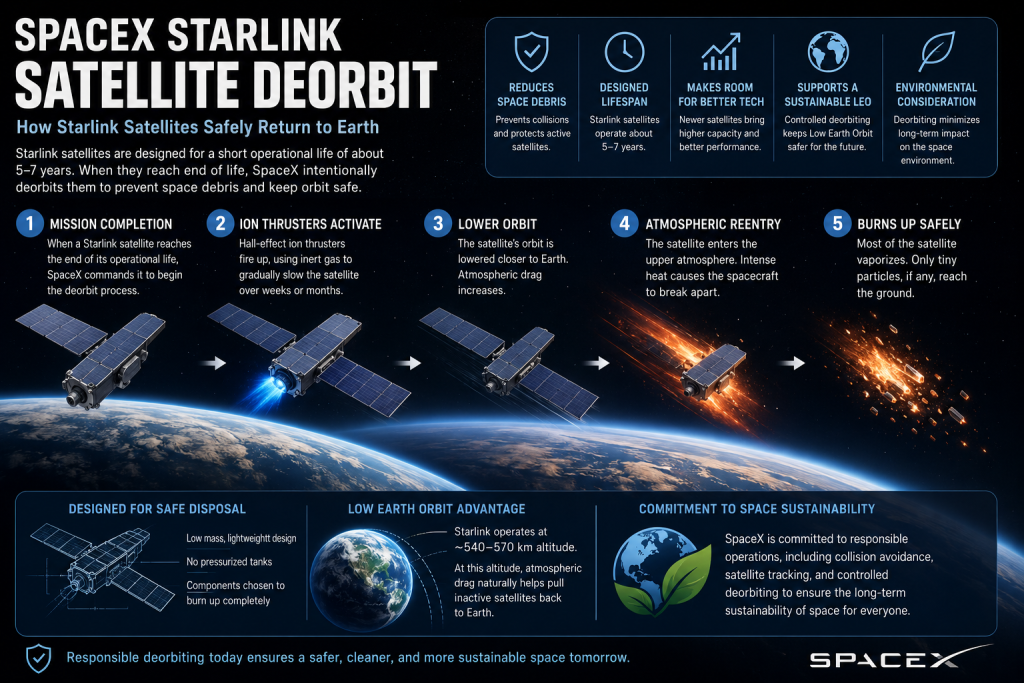
SpaceX Starlink Satellite Deorbit: Everything You Need to Know
The rapid expansion of SpaceX’s Starlink network has transformed global internet connectivity. With thousands of satellites already in orbit and thousands more planned, one question continues to attract attention:
What happens when a Starlink satellite reaches the end of its life?
The answer lies in a carefully planned process called satellite deorbiting. Rather than leaving old satellites as dangerous space junk, SpaceX intentionally guides them back toward Earth’s atmosphere, where they safely burn up.
As the world’s largest satellite constellation continues to grow, understanding the Starlink satellite deorbit process is becoming increasingly important for scientists, policymakers, and everyday internet users.
In this article, we’ll explain:
- What Starlink satellite deorbit means
- Why satellites are intentionally removed
- How the deorbit process works
- Environmental concerns
- Space debris mitigation
- Frequently asked questions
What Is a Starlink Satellite?
Starlink is a satellite internet system developed by SpaceX to provide high-speed broadband internet around the world, especially in rural and underserved areas.
Unlike traditional communications satellites that orbit about 36,000 km above Earth, Starlink satellites operate in Low Earth Orbit (LEO) at roughly 540–570 km altitude.
This lower orbit offers:
- Lower latency
- Faster internet speeds
- Better global coverage
- Easier replacement of satellites
As of 2026, thousands of Starlink satellites are operating simultaneously.
What Does Satellite Deorbit Mean?
A satellite deorbit is the controlled process of lowering a satellite’s orbit until it re-enters Earth’s atmosphere.
Once the satellite enters the atmosphere:
- Atmospheric friction rapidly increases
- Temperatures exceed several thousand degrees
- Most of the spacecraft burns into tiny particles
- Little or no debris reaches the ground
For Starlink satellites, this process is intentionally designed into every mission.
Why Do Starlink Satellites Need to Deorbit?
There are several important reasons.
1. Prevent Space Debris
One of the biggest challenges facing modern spaceflight is orbital congestion.
Dead satellites can collide with:
- Active satellites
- Space stations
- Rockets
- Other debris
Even a tiny object traveling at 28,000 km/h can cause catastrophic damage.
Removing retired satellites reduces collision risks.
2. Limited Satellite Lifespan
Starlink satellites are not designed to last forever.
Their average operational lifetime is approximately:
5–7 years
Reasons include:
- Solar radiation
- Electronics aging
- Battery degradation
- Fuel depletion
- Component wear
Instead of becoming abandoned objects, they are safely removed.
3. Make Room for Newer Technology
Space technology evolves rapidly.
Each new generation of Starlink satellites includes improvements in:
- Internet capacity
- Laser communication
- Power efficiency
- Collision avoidance
- Radiation resistance
Older satellites are replaced with newer, more capable versions.
How Does a Starlink Satellite Deorbit?
The process is surprisingly sophisticated.
Step 1: Mission Completion
Once the satellite reaches the end of its operational life, SpaceX commands it to begin retirement.
Step 2: Ion Thrusters Activate
Each Starlink satellite uses a Hall-effect ion thruster.
Instead of large rocket engines, these thrusters gradually lower the satellite’s orbit over weeks or months.
The propulsion system uses inert gases to generate gentle but efficient thrust.
Step 3: Lower Orbit
As altitude decreases, Earth’s atmosphere becomes denser.
Atmospheric drag naturally slows the satellite.
Step 4: Atmospheric Reentry
Eventually the spacecraft enters Earth’s upper atmosphere.
The intense heat generated during reentry causes the satellite to disintegrate.
Nearly all components vaporize before reaching Earth’s surface.
What Happens if a Starlink Satellite Fails?
SpaceX designed Starlink satellites with an additional safety feature.
If communication is lost:
- The satellite cannot maintain its orbit indefinitely.
- Atmospheric drag gradually pulls it lower.
- Eventually it naturally re-enters Earth’s atmosphere.
Because Starlink satellites operate relatively low compared to many other spacecraft, they are expected to decay naturally within several years even without active control.
Are Starlink Satellites Safe During Reentry?
Generally, yes.
Starlink satellites are intentionally designed to:
- Burn up almost completely
- Leave minimal surviving debris
- Reduce risk to populated areas
Most of the spacecraft is made from lightweight materials that disintegrate during atmospheric reentry.
The chance of a surviving fragment causing injury is considered extremely low.
Environmental Concerns
Despite the safety of controlled reentry, scientists continue studying possible environmental effects.
Aluminum Oxides
Many satellites contain aluminum.
When they burn up:
- Aluminum particles form
- Aluminum oxide enters the upper atmosphere
Researchers are investigating whether increasing satellite reentries could affect atmospheric chemistry over the long term.
Atmospheric Pollution
The growing number of satellite reentries has raised questions about:
- Metal particle accumulation
- Ozone interactions
- Climate effects
- Mesosphere chemistry
Current research is ongoing, and there is no scientific consensus that existing reentry levels are causing significant global environmental harm. However, the increasing pace of satellite launches has prompted continued monitoring.
Starlink and Space Debris Mitigation
SpaceX employs several strategies to reduce orbital debris.
Autonomous Collision Avoidance
Starlink satellites can automatically maneuver to avoid collisions with:
- Other satellites
- Rocket bodies
- Space debris
Low Orbit Design
Operating in Low Earth Orbit provides a natural safety mechanism.
Even without propulsion, atmospheric drag eventually removes inactive satellites.
Controlled Disposal
Instead of abandoning satellites, SpaceX actively deorbits them at the end of their missions.
Challenges of Large Satellite Constellations
As more companies launch satellite constellations, several challenges emerge.
Crowded Orbits
Thousands of satellites share similar orbital regions.
This increases:
- Collision probability
- Tracking complexity
- Space traffic management needs
Astronomy
Astronomers have expressed concerns that large satellite constellations can interfere with observations by creating bright streaks across telescope images.
SpaceX has tested design changes, such as darker coatings and sunshades, to reduce satellite brightness.
International Regulation
Governments and international organizations continue developing guidelines for:
- Satellite disposal
- Collision avoidance
- Space traffic coordination
- Orbital sustainability
Effective cooperation will be increasingly important as commercial satellite networks expand.
Future Improvements
Future generations of Starlink satellites are expected to include:
- Better propulsion systems
- Improved autonomous navigation
- Lower reflectivity
- Enhanced collision avoidance
- More sustainable spacecraft materials
- Increased reliability
These improvements aim to support long-term, responsible use of Low Earth Orbit.
Frequently Asked Questions
How long does a Starlink satellite last?
Most Starlink satellites are designed to operate for approximately 5 to 7 years before being replaced.
Why do Starlink satellites burn up?
Controlled atmospheric reentry prevents old satellites from becoming long-term space debris and reduces collision risks.
Can Starlink satellites survive reentry?
They are designed to burn up almost completely during atmospheric reentry. Only tiny fragments, if any, are expected to survive.
How many Starlink satellites deorbit each year?
The exact number varies depending on launches, replacements, satellite upgrades, and operational needs. As the constellation expands, annual deorbits are expected to increase as part of routine fleet management.
Do deorbiting satellites create pollution?
Satellite reentries release small amounts of metal oxides into the upper atmosphere. Scientists are actively studying the cumulative environmental effects, but more research is needed to understand long-term impacts.
Conclusion
The SpaceX Starlink satellite deorbit process is a key part of responsible satellite operations. By intentionally guiding aging satellites back into Earth’s atmosphere, SpaceX helps reduce space debris, lower collision risks, and maintain the long-term sustainability of Low Earth Orbit.
As satellite constellations continue to grow, controlled deorbiting, improved collision avoidance systems, and international cooperation will play an increasingly important role in preserving the space environment. While researchers continue to study the environmental effects of frequent satellite reentries, the Starlink program demonstrates how commercial space operators can incorporate end-of-life planning into large-scale satellite networks.
For internet users, space enthusiasts, and policymakers alike, understanding satellite deorbiting offers valuable insight into how modern space infrastructure is managed—and why responsible disposal is just as important as launching satellites in the first place.